People study culinary arts to turn an interest in food into a professional craft with real career options. A good programme teaches technique, food safety, costing and kitchen leadership, and opens routes into hotels, restaurants, bakeries, F&B brands and food businesses of your own. It suits people who enjoy discipline as much as creativity.
This guide explains what culinary arts involves, the strongest reasons to study it, what the career looks like in India, how formal training compares with learning on the job, and who should think twice before enrolling. Where we use figures, we name the source and the date.
What Is Culinary Arts?
Culinary arts is the professional practice of preparing, cooking and presenting food, together with the systems that make a kitchen work: food safety, costing, purchasing, menu planning and team management. It covers savoury cuisine and, usually as a specialism, pastry and bakery.
Studying culinary arts means learning these skills in a structured sequence in professional kitchens, then applying them in real workplaces. Degree and postgraduate programmes add business subjects, so graduates can move into management or run their own food ventures.
At École Ducasse India, the Indian campus of École Ducasse on the ISH campus in Gurugram, you can study culinary arts through undergraduate and postgraduate programmes, or through dual-campus diplomas that continue in France or Singapore.
Why Study Culinary Arts? Seven Reasons
The strongest reasons to study culinary arts are a hands-on craft you can measure, a large and growing food economy in India, careers that reach beyond restaurant kitchens, a direct route to entrepreneurship, skills that travel internationally, a faster path to kitchen leadership, and work that combines creativity with discipline.
1. You learn a hands-on craft you can see and measure
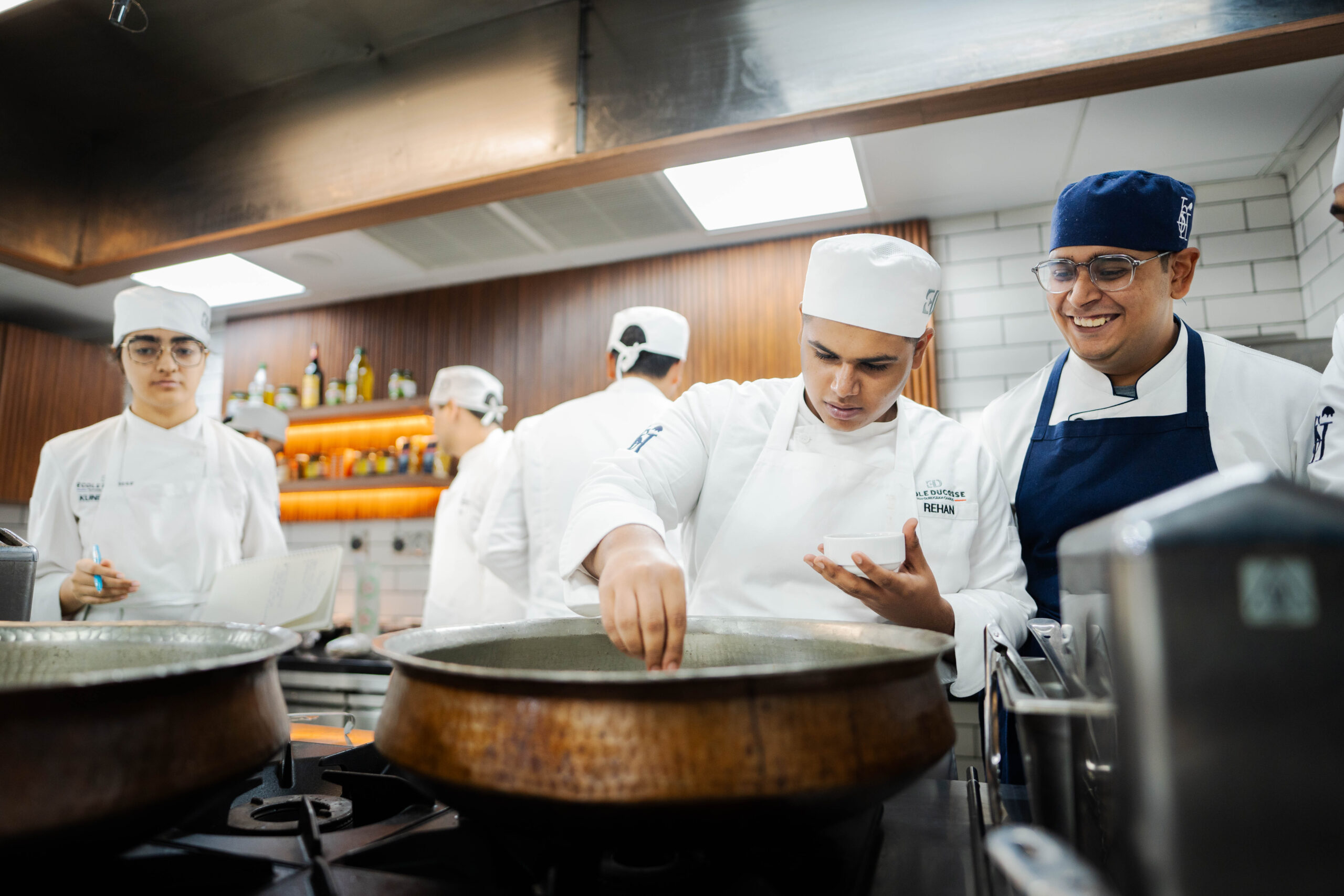
Culinary education is mostly practical. You build knife skills, mise en place, stocks, sauces, cooking methods and plating, and you are assessed on the dishes you produce, not only on written exams. Progress is visible: a dish is either consistent service after service, or it is not.
For people who learn best by doing, that is a strong reason in itself. Every skill you practise, from portion control to hygiene routines, is used daily in a working kitchen.
2. India’s food services sector is large and still growing
According to the National Restaurant Association of India’s India Food Services Report 2024, the sector was worth about ₹5.69 lakh crore in FY24, directly employed about 8.5 million people, and was projected to reach about ₹7.76 lakh crore by FY28, with the organised segment growing at 13.2% a year.
A newer NRAI and Redseer Strategy Consultants report, reported in July 2026, projects the market to reach about US$150 billion by FY31. It expects organised brands, including quick-service chains, cafés, cloud kitchens and casual dining, to take a growing share of spending. That matters for culinary graduates, because organised operators typically hire into defined roles with training programmes and promotion ladders.
3. The career paths go well beyond restaurant kitchens
Most culinary careers start in a kitchen brigade, moving from commis chef to chef de partie, sous chef and head chef. The same training also leads to many other destinations:
Hotels and resorts, including banqueting and multi-outlet kitchens.
Bakeries, patisseries and chocolate businesses.
Members clubs, catering companies and cloud kitchens.
F&B brands, product development and food marketing.
Hospitality education and training.
Many professionals spend their early years cooking before moving into operations, product or brand roles, because kitchen experience gives them credibility with chefs later.
4. It is one of the most direct routes to running your own food business
Many people study culinary arts because they want to open a café, bakery, cloud kitchen or restaurant. Training that covers costing, menu engineering, purchasing, food safety and people management matters here, because those skills often decide whether a food business survives.
In ISH’s Class of 2026, 27% of graduates across its liberal hospitality and culinary arts undergraduate programmes chose entrepreneurship or a family enterprise as their outcome, reported separately from placement. École Ducasse India’s B.A. (Hons.) in Culinary Arts at ISH offers an Entrepreneurship specialisation from Semester 5, in which students design new business ideas and test them with mentors.
Food businesses in India are also regulated. Under the FSSAI FoSTaC programme, food businesses holding central or state licences should have at least one trained and certified Food Safety Supervisor for every 25 food handlers on each premises. Culinary training that takes food safety seriously prepares you for that responsibility.
5. Culinary skills travel internationally
Core cooking techniques and kitchen systems are shared across the world, which makes culinary skills portable. Your right to work in another country still depends on its visa and labour rules, but international training and work experience make the move easier.
Experienced kitchen leaders remain in demand in mature markets. In the United States, the Bureau of Labor Statistics projects employment of chefs and head cooks to grow 7% from 2025 to 2035, with about 25,200 openings a year on average. That figure describes the US labour market only.
At École Ducasse India, the diplomas are dual-campus pathways: the Culinary Arts Diploma continues at École Ducasse Paris, and the Diploma in Culinary Arts continues at At-Sunrice GlobalChef Academy in Singapore, both with a paid internship.
6. Formal training can shorten the path to leadership
You do not need a qualification to cook professionally. The US Bureau of Labor Statistics notes that chefs and head cooks typically need a high school diploma and work experience, and that some attend culinary programmes while others learn through apprenticeships.
What formal training adds is sequence and breadth. You learn foundations, food safety, costing and management in a set order, rather than depending on which kitchen and which chef you happen to train under. That foundation helps when you are ready to run a station, a kitchen or a business.
7. It combines creativity with discipline
Culinary arts rewards creativity, but professional kitchens run on precision, timing and repetition. Chef Manish Mehrotra, quoted on the B.A. (Hons.) in Culinary Arts page, names the values that build great kitchens as “discipline, simplicity, and respect for process”.
If you enjoy getting the same dish exactly right every time, and then finding ways to improve it, culinary arts is likely to suit you.
Why Study Culinary Arts Formally Instead of Learning on the Job?
Study culinary arts formally if you want structured foundations, management skills, a recognised credential or international pathways. Learning on the job can be enough if you already have access to a strong kitchen and mentor, and you do not need a qualification for further study or work abroad.
Factor
Formal culinary education
Learning on the job
Upfront cost
Tuition and living costs
Low; you earn from the start
Foundations
Taught in sequence: technique, food safety, costing
Depends on the kitchen and the chef
Business and management skills
Built into degree and postgraduate programmes
Learned informally, if at all
Credential
A recognised qualification for jobs and further study
None
International options
Partner campuses and internships abroad
Harder to arrange
If you are a graduate switching into culinary arts, the one-year PGCM in Culinary Arts at École Ducasse India, ISH combines professional kitchen training with management and entrepreneurship, and ends with a structured work attachment.
Is Culinary Arts a Good Career in India?
Culinary arts can be a good career in India if you are prepared for demanding early years. Pay usually starts modestly and rises through promotion, and the work involves long shifts, evenings and weekends. Graduates who keep building skills can progress into sous chef, head chef, management or business ownership.
Salaries depend on the employer and the career ladder you join. For École Ducasse India’s B.A. (Hons.) in Culinary Arts Class of 2026, ISH’s Class of 2026 Graduate Outcomes report records a median management training salary of ₹3.6 lakh per annum, rising to a median of ₹6.0 lakh per annum on completion of the employer’s training programme, based on confirmed records. That is one cohort at one school, so treat it as a benchmark, not a promise.
Working conditions matter as much as pay. The US Bureau of Labor Statistics describes chefs and head cooks as often working early mornings, late evenings, weekends and holidays in a hectic, fast-paced environment. Before committing, spend time in a professional kitchen to see whether that rhythm suits you.
Who Should Study Culinary Arts?
Culinary arts suits people who like physical, practical work, stay organised under pressure and are willing to repeat a technique until it is right. It suits people less well if they want predictable office hours or expect a senior title soon after graduating.
Culinary arts is likely to suit you if you:
Enjoy working with your hands and seeing results quickly.
Stay calm and organised when orders are coming in fast.
Are happy to repeat a technique until it is consistent.
Are curious about ingredients, cuisines and how food businesses work.
Want the option of running your own food venture one day.
Think twice if you:
Want a predictable nine-to-five schedule.
Dislike physical work and long periods on your feet.
Expect a senior title soon after graduating.
Are drawn mainly by television cooking rather than daily service.
The simplest test is to spend a few days in a professional kitchen or take a short course before committing to a full programme. ISH’s short-term programmes include Explore the Fundamentals of Food, which covers knife skills, pasta, sauces and balance.
Why Study Culinary Arts at École Ducasse India?
École Ducasse India is the Indian campus of École Ducasse, hosted on the ISH campus in Gurugram. Its programmes combine professional kitchen training and chef-mentors with business subjects and structured work attachments with hospitality and F&B brands.
École Ducasse India at ISH — the Indian campus of École Ducasse, named the World’s Best Culinary Training Institution three consecutive times in 2023, 2024 and 2025.
12 months (ENSP, Yssingeaux) or 16 months (At-Sunrice)
Candidates focused on pastry, bread and chocolate
ISH reports on its Impact in Numbers page that 80% of its students are supported through need-based scholarships, and that about 25% have progressed to Les Roches and École Ducasse for second degrees at undergraduate, diploma and postgraduate levels.
Common Misconceptions About Studying Culinary Arts
“Culinary arts is just cooking.” It also covers food safety, costing, purchasing, menu planning and team leadership.
“A culinary qualification makes you a head chef.” It speeds up your foundations; senior titles still come from years of performance.
“Culinary careers mean restaurants only.” Hotels, bakeries, clubs, catering, F&B brands and education all hire culinary talent.
“You must already be a skilled cook to enrol.” Good programmes teach foundations from the start, including classical techniques, knife skills, mise en place, stocks and sauces.
“Passion is enough.” Stamina, reliability and consistency matter just as much in the first years.
Frequently Asked Questions
Why should I study culinary arts?
Study culinary arts if you want to turn an interest in food into a professional craft with real career options. Good programmes teach technique, food safety, costing and kitchen leadership, and lead to roles in hotels, restaurants, bakeries, F&B brands and food businesses of your own. It suits people who enjoy discipline and repetition as much as creativity.
Is culinary arts a good career in India?
It can be, if you accept demanding early years. India’s food services sector directly employed about 8.5 million people in 2024, according to NRAI. Pay usually starts modestly and rises through promotion; for ISH’s B.A. (Hons.) in Culinary Arts Class of 2026, the median rose from ₹3.6 lakh per annum during training to ₹6.0 lakh per annum on completion.
What do you learn in a culinary arts programme?
You learn cooking techniques, knife skills, mise en place, stocks and sauces, pastry foundations, plating, food safety and kitchen discipline. Degree and postgraduate programmes add business subjects such as costing, operations and entrepreneurship, plus structured work attachments where you apply your training in real hospitality and F&B workplaces.
Do I need culinary school to become a chef?
No. Many chefs learn on the job, and the US Bureau of Labor Statistics notes that chefs and head cooks typically need a high school diploma and work experience. Culinary school is a faster, more structured route that adds management skills, a recognised credential and international pathways, which help if you want to lead kitchens, study further or work abroad.
Can I study culinary arts after Class 12?
Yes. School leavers can apply to undergraduate programmes such as École Ducasse India’s B.A. (Hons.) in Culinary Arts at ISH, an eight-semester Gurugram University degree that combines culinary and pastry techniques with business subjects and two structured work attachments. Check each programme’s admissions page for current eligibility requirements.
Is culinary arts only about working in restaurants?
No. Culinary graduates work in hotels and resorts, bakeries and patisseries, members clubs, catering companies, cloud kitchens, F&B brands, product development, food marketing and hospitality education. Many start in a kitchen because that experience gives them credibility later, then move into management, brand or business roles.
Next Step: Test Your Interest, Then Compare Programmes
If culinary arts appeals to you, test it before you commit: spend time in a professional kitchen or take a short course. Then compare programmes on credential, kitchen time, work attachments, international options, total cost and verified graduate outcomes for their most recent culinary cohort.
The best culinary degree in India is the one that gives you a recognised qualification, extensive time in professional kitchens, structured work experience with real employers, business skills and verified, dated graduate outcomes. No single programme is best for every student, so judge each one on those five points rather than on its reputation alone.
For school leavers who want both kitchen skill and a management career, École Ducasse India’s B.A. (Hons.) in Culinary Arts at ISH is built around those points. It is an eight-semester Gurugram University degree that combines culinary and pastry techniques with business subjects, two structured work attachments and a specialisation from Semester 5, with an optional final year at École Ducasse Paris or ENSP in France.
École Ducasse India at ISH — the Indian campus of École Ducasse, named the World’s Best Culinary Training Institution three consecutive times in 2023, 2024 and 2025.
If a four-year degree is not the right fit, École Ducasse India also offers shorter routes on the ISH campus in Gurugram: the one-year, AICTE-approved PGCM in Culinary Arts for graduates and career changers, and diploma programmes that begin in Gurugram and continue in France or Singapore. The rest of this guide shows how to compare these options against the careers, salaries and hiring timelines they lead to.
Culinary Careers at a Glance
A culinary degree or diploma prepares you for professional kitchen roles such as commis chef, chef de partie and, with experience, sous chef, as well as careers in hotels, bakeries, members clubs, catering, F&B brands, product development and food entrepreneurship. It does not guarantee a job. Your outcome depends on training quality, internships, skills and the employer ladder you join.
This guide answers the questions students, parents and career changers ask most often before choosing culinary education: what jobs exist, how long hiring takes, what graduates actually earn, whether culinary school is necessary and whether it is worth the cost. Where we use figures from Indian School of Hospitality (ISH) and École Ducasse India, we say which cohort and date they describe. Where we use industry data, we name the source.
Question
Short answer
What jobs can culinary graduates get?
Kitchen brigade roles in hotels, restaurants, bakeries and clubs, plus catering, cloud kitchens, F&B brands, product development, food marketing, hospitality education and entrepreneurship.
Do you need culinary school to cook professionally?
No. Many chefs learn on the job. Formal training speeds up foundations and opens management and international pathways.
How long until a graduate is hired?
Often around graduation, through internships and pre-placement offers, but timelines vary. No school can honestly guarantee a job.
What do graduates earn at the start?
For ISH’s B.A. (Hons.) Culinary Arts Class of 2026, the median was ₹3.6 lakh per annum during employer training and ₹6.0 lakh per annum on completion.
Is culinary school worth it?
It can be, when the programme’s cost, length, internships and employer network match your goals. ROI depends on those variables, not on the certificate alone.
Do You Need Culinary School to Cook Professionally?
No. Formal education is not required to work in a professional kitchen, and many successful chefs learned entirely on the job. The US Bureau of Labor Statistics notes that most chefs and head cooks learn their skills through work experience, typically starting as line cooks and spending years in kitchens before promotion. Culinary school is a faster, more structured route, not the only route.
Whether it is the right route depends on what you want in five to ten years, not just what you want to cook next month.
Factor
Formal culinary training
Learning on the job
Upfront cost
Tuition and living costs, sometimes abroad
Low; you earn from day one
Speed of foundations
Structured: technique, food safety, costing and theory in sequence
Depends on your kitchen and chef; can be uneven
Entry point
Often management training or organised-sector roles
Formal training tends to pay off most when you want to lead kitchens or businesses, work for organised employers, study or work abroad, or keep the option of a management career outside the kitchen. Learning on the job can be enough when you are certain about a specific kitchen, have access to a strong mentor chef and do not need a formal credential.
How do I know if a culinary career is right for me?
Test the reality before you commit to years of study. Professional kitchens involve long shifts on your feet, evening and weekend work, heat, pressure and repetition. People who thrive usually enjoy the discipline as much as the creativity.
Spend a few days shadowing in a professional kitchen, even unpaid, to see a real service.
Cook the same dish repeatedly until it is consistent; professional cooking is about consistency more than novelty.
Visit campuses, meet current students and ask what their weeks look like. ISH hosts campus events and open days.
Is a Culinary Qualification Recognised by Employers?
A culinary qualification is only as recognised as the body that awards it, so check who issues the certificate. At ISH, recognition comes from several sources, as set out on its accreditations and memberships page:
The B.A. (Hons.) in Culinary Arts is a Gurugram University degree. ISH states the qualification carries legal validity across India in line with UGC norms. Students who transfer to France for their final year also earn an International Bachelor’s Degree from École Ducasse.
The Postgraduate Certificates in Management in Culinary Arts and Bakery and Pastry are AICTE-approved.
All ISH culinary programmes are delivered under the École Ducasse academic framework. École Ducasse was named World’s Best Culinary Training Institution at the World Culinary Awards in 2023, 2024 and 2025.
Can culinary graduates work anywhere in the world?
Culinary skills are highly portable, but the right to work abroad depends on each country’s visa and labour rules, not on your qualification alone. International pathways make the move easier. For the Paris diploma, École Ducasse’s career development centre guides graduates on work pathways available under French law. Across both ISH undergraduate programmes, 15% of the Class of 2026 moved into international pathways.
How to Choose the Right Culinary Programme
Choose a culinary programme by matching its length, credential, practical hours and career outcomes to your goal, then verify its claims. Start with where you want to be in five years, whether that is running a hotel kitchen, opening a bakery or working abroad, and work backwards.
Define your goal: kitchen leadership, pastry, entrepreneurship, international work or a management career.
Check the credential: who awards it, and is it recognised for jobs and further study?
Count practical time: hours in professional kitchens and the length and pay of internships.
Verify outcomes: ask for dated, cohort-specific placement and salary data for culinary graduates.
Meet the faculty: chef-faculty with industry experience shape your network.
Calculate total cost: include living costs, international phases and financial aid.
ISH’s culinary portfolio at École Ducasse India illustrates how the options differ:
Programme
Duration
Where
Qualification
Best suited to
B.A. (Hons.) in Culinary Arts
Eight semesters
Gurugram, with an optional final year at École Ducasse Paris or ENSP
Gurugram University degree; École Ducasse certification or degree
School leavers who want culinary skill plus a business specialisation
PGCM in Culinary Arts
12 months
Gurugram
AICTE-approved postgraduate certificate
Graduates, career changers and aspiring founders
Culinary Arts Diploma, École Ducasse Paris
12 months
Gurugram and Paris
École Ducasse Paris diploma
Candidates aged 18 or above seeking French culinary training
Diploma in Culinary Arts, At-Sunrice
16 months
Gurugram and Singapore
SSG-recognised At-Sunrice diploma
Candidates wanting Asian and contemporary cuisine and a paid Singapore internship
A good culinary programme is mostly practical. You spend extensive time in professional-grade kitchens building technique, speed and discipline, and then apply it in real workplaces through internships or work attachments. The better programmes add business skills such as costing, menu design and operations management.
What to expect from culinary training
At ISH, the foundations phase of the culinary diplomas covers classical techniques, knife skills, mise en place, stocks and sauces, kitchen discipline, food safety and HACCP, and the basics of menu thinking. Later phases add advanced cuisine, plating, restaurant operations and, depending on the programme, French gastronomy or Asian and contemporary cuisine. The four-year B.A. (Hons.) in Culinary Arts combines culinary and pastry techniques with business subjects and two structured work attachments.
Expect uniforms, hygiene standards, punctuality rules and practical assessments. Culinary school mirrors a professional kitchen deliberately, because that is where you will be judged.
What should culinary students know before enrolling?
Your first job is likely to be junior, even with a degree. Qualifications speed up progression; they rarely let you skip the line entirely.
Internships shape your first job more than grades do. Treat them as long interviews.
Physical stamina and reliability matter as much as talent in the first years.
Specialising early, in pastry for example, can help, but a broad foundation keeps options open.
Read any placement statistic together with its definition and date.
How culinary schools connect students to jobs
Culinary schools connect students to employers through built-in internships, industry relationships, recruiter visits and career services. At ISH, the Centre for Career Development works with the Centre for Life Skills to match students with employers on company-student fit, through internships, mentorships and full-time roles.
International diplomas at ISH build paid work experience into the programme itself:
The Culinary Arts Diploma with École Ducasse Paris is a 12-month pathway, 3 months in Gurugram and 9 months in Paris, including a four-month paid internship in France with a stipend of €450 to €600 per month, depending on the employer.
Employers of ISH’s Class of 2026 included Marriott International, which made culinary pre-placement offers, alongside hotel groups such as The Oberoi Group, The Leela and Hilton, and food businesses such as Manam Chocolate.
Questions to ask any culinary school about placement support
What percentage of last year’s culinary cohort had confirmed offers, and on what date was that measured?
Does the figure include students who chose entrepreneurship, further study or opted out, or are they reported separately?
Which employers hired culinary graduates specifically, not the whole school?
What was the median starting salary, and is it the training salary or the post-training salary?
Are internships guaranteed, paid and assessed?
What Can You Do With a Culinary Degree or Diploma?
A culinary qualification leads first to professional kitchen roles, most commonly as a commis chef or management trainee, and from there to senior brigade positions. It also opens careers outside restaurant kitchens: hotels and resorts, members clubs, bakeries and patisseries, catering, production kitchens, F&B brands, food marketing, hospitality education and your own food venture.
The breadth matters because the food economy is large and still formalising. The National Restaurant Association of India’s India Food Services Report 2024 estimates the sector at about ₹5.69 lakh crore, employing roughly 8.5 million people directly, with the organised segment projected to grow at 13.2% a year to 2028. Organised operators, from hotel chains to multi-brand restaurant groups, are the employers most likely to hire trained culinary graduates into structured roles.
Kitchen careers: the brigade ladder
Most culinary careers begin inside a kitchen brigade, the hierarchy used by hotels and serious restaurants. Titles vary between employers, but the progression is broadly consistent:
Commis chef or kitchen trainee: the entry role, preparing ingredients and executing set recipes on one station under supervision.
Demi chef de partie and chef de partie: running a station, such as sauces, grill, garde manger or pastry, and training juniors.
Junior sous chef and sous chef: managing shifts, ordering, rostering, costing and quality across the kitchen.
Head chef or executive chef: owning menus, food cost, hiring and the kitchen’s standards; in hotels, often overseeing several outlets.
Pastry and bakery follow a parallel ladder, leading to pastry chef, head baker or chocolatier roles.
Culinary career paths beyond restaurant kitchens
Not every culinary graduate stays on a restaurant line. Employers of ISH’s Class of 2026 across its hospitality and culinary programmes came from hotels and resorts, F&B brands and breweries, restaurants and cafés, members clubs, experiential and boutique hospitality, mobility and retail, and hospitality education, according to the ISH Class of 2026 Graduate Outcomes report. ISH’s programme pages list further destinations for culinary and pastry graduates:
Bakeries, patisseries and dessert studios.
Food studios and production kitchens.
Catering companies and cloud kitchens.
F&B management, concept development and franchise operations.
Nutrition-focused food ventures and consulting.
Food marketing and PR, a pipeline in process for ISH’s Class of 2026 culinary graduates.
These paths reward the same foundations as a kitchen career, so many professionals spend their early years cooking before moving into product, operations or brand roles.
Do all culinary graduates work in kitchens?
Most start there, and that is usually an advantage rather than a limitation. For ISH’s B.A. (Hons.) Culinary Arts Class of 2026, confirmed placements were concentrated in culinary operations, with a smaller marketing and PR pipeline still in process. Kitchen experience is what gives a food marketer, product developer or F&B manager credibility with chefs later.
Can culinary training lead to owning a food business?
Yes, when the training covers business as well as cooking. Costing, menu engineering, supply chains, food safety compliance and people management decide whether a restaurant, bakery or cloud kitchen survives, often more than recipes do. Across both ISH undergraduate programmes, 27% of the Class of 2026 chose entrepreneurship or family enterprise as their outcome, reported separately from placement.
ISH builds this in two ways. The B.A. (Hons.) in Culinary Arts offers an Entrepreneurship specialisation from Semester 5, where students design and test a venture concept with mentors. The Postgraduate Certificate in Management in Culinary Arts is designed partly for aspiring founders and family-business participants who want to professionalise operations.
One practical point for founders in India: licensed food businesses are expected to have at least one trained and certified Food Safety Supervisor for every 25 food handlers on each premises under FSSAI’s FoSTaC programme. Food safety is a legal and operational foundation of any food business, not an afterthought.
What Employers Look For in Culinary Graduates
Employers hiring culinary graduates look first for reliability, sound fundamentals and food safety discipline, then for speed, consistency, teamwork and the ability to take feedback. Creativity matters, but in the first years it counts only after you can execute the menu exactly as specified, every service.
Technique fundamentals: knife skills, mise en place, stocks, sauces and cooking methods executed consistently.
Food safety: HACCP principles and hygiene habits. Food safety is regulated in India through FSSAI requirements such as trained Food Safety Supervisors.
Speed and organisation: a clean, prepared station and the ability to work to ticket times.
Teamwork and communication: kitchens run on clear call-and-response and mutual support.
Cost awareness: understanding portioning, yield and waste signals management potential.
Coachability and stamina: turning up on time, every shift, and improving from feedback.
What employers expect from new culinary graduates in the first months
Expect to be tested on basics before you are trusted with more. New graduates typically prove themselves on prep and one station, learn the kitchen’s recipes and standards exactly, and show they can handle a full service. Graduates who ask questions, take notes and volunteer for extra prep tend to be moved up fastest.
How culinary graduates stand out to employers
Treat every internship as a trial; many first jobs come from internship employers.
Keep a photo and recipe portfolio of dishes you have executed professionally.
Build a specialism alongside a broad base, such as pastry, a regional cuisine or bread.
Learn the business side: food cost, menu engineering and inventory.
Get international exposure where possible; it signals adaptability.
How Long Does It Take a Culinary Graduate to Get Hired?
Many culinary graduates receive offers during or shortly after their final internship or work attachment, often as pre-placement offers from the employer they trained with. Others take a few months to find the right role, particularly if they are selective about city, cuisine or employer. No reputable school can guarantee a job or a timeline.
For a real benchmark, ISH’s Class of 2026 Graduate Outcomes report documents every graduate of its B.A. (Hons.) Culinary Arts programme, which began in 2022. As recorded on 7 July 2026:
41% of the culinary cohort held confirmed offers.
73% held confirmed offers or offers in process, such as verbal confirmations and offer letters awaited.
The remaining graduates were reported under distinct outcomes: entrepreneurship and family enterprise, international pathways, higher studies, exploring options and opting out of the placement process.
The report treats entrepreneurship and further study as chosen outcomes rather than failures, and excludes offers in process from its salary statistics until they are confirmed in writing. That level of disclosure is what to look for when comparing schools.
Do restaurants and hotels hire fresh culinary graduates?
Yes. Hotels, restaurant groups and bakeries hire fresh graduates into entry-level brigade roles and structured management training programmes. NRAI projects direct employment in Indian food services to grow from about 8.5 million people in 2024 to about 10.3 million by 2028, which sustains steady demand for trained kitchen talent. Competition is stiffer for the most prestigious kitchens, where employers can choose from many applicants.
Will culinary school guarantee me a job?
No, and you should be wary of any school that promises one. A strong programme improves your odds through technique, internships and employer relationships. Your outcome still depends on how you perform during internships, how flexible you are about role and location, and whether you keep building skills after graduation.
What is the culinary job market really like?
The Indian food services market is large and growing, but the work is demanding. NRAI estimates the industry will reach about ₹7.76 lakh crore by 2028, growing at 8.1% a year, with the organised segment growing faster than the unorganised one. For graduates, that means more structured employers with training programmes and career ladders. It also means competition for the best roles and early-career pay that rises mainly through promotion.
The honest picture: entry is achievable for trained, reliable graduates; progression is earned; and the first two to three years are the hardest physically and financially.
What is life like after culinary school?
Life after culinary school usually begins with a structured training period at an employer, such as a hotel management training programme or a kitchen rotation, followed by a permanent role on a station. Expect shift work, a steep learning curve and frequent feedback. Graduates who treat the first year as a paid extension of their education tend to progress fastest.
How Much Do Culinary Graduates Earn in India?
Starting salaries for culinary graduates in India vary widely by employer and career ladder. For ISH’s B.A. (Hons.) Culinary Arts Class of 2026, the median management training salary was ₹3.6 lakh per annum, rising to a median of ₹6.0 lakh per annum on completion of the employer’s training programme, based on eight confirmed records.
Career ladder (Class of 2026, culinary)
Management training salary (₹ LPA)
On completion of training (₹ LPA)
Premium kitchen management ladder
4.80
9.00
Hotel and standalone culinary brigade ladder (operations)
3.00
6.00
Boutique kitchen management ladder
3.60
5.00
Cohort median
3.60
6.00
Source: ISH Class of 2026 Graduate Outcomes report, confirmed records as of 7 July 2026. LPA means lakh per annum. The figures describe one cohort and one school; they are a benchmark, not a promise.
Several factors move a starting salary more than the qualification itself:
Employer ladder: premium and luxury kitchens tend to pay more on completion than standalone brigades.
Training structure: management training programmes pay less during training and step up on completion.
City and segment: metro hotels and premium restaurants usually pay more than smaller markets.
Specialisation: pastry, bakery and specific cuisines can command different rates depending on demand.
International experience: paid internships abroad, such as those in France and Singapore, add earnings during study and experience employers value.
For international context, the US Bureau of Labor Statistics reports a 2025 median pay of $62,470 for chefs and head cooks and $36,640 for cooks. These figures reflect a different labour market and cost of living, so they are useful for understanding the gap between junior and senior roles, not for converting into rupees.
How Quickly Can Culinary Graduates Advance?
Advancement in kitchens is earned through performance and time on stations. The US Bureau of Labor Statistics notes that chefs and head cooks typically need a high school diploma plus work experience, with many spending years in kitchens before promotion. Professional certification in the US requires anywhere from about six months to five years of experience, depending on the level.
Formal training can shorten the path by giving you management skills earlier. The employer career ladders documented for ISH’s Class of 2026 culinary graduates map progression toward Junior Sous Chef, Sous Chef and Head of Kitchen roles at around the five-year stage. Actual progression depends on individual performance and the employer.
What accelerates promotion in practice: consistency under pressure, willingness to train juniors, understanding food cost and inventory, and moving deliberately between employers or outlets to gain breadth.
Watch: Chef Manish Mehrotra on the reality of a chef’s journey
In conversation with Kunal Vasudeva, Chef Manish Mehrotra talks about leaving Indian Accent at the height of his career to build Nisaba, his vision for modern Indian cuisine and what it takes to become a restaurateur. He also covers finding the right investors, building teams, nurturing young chefs and the discipline of the kitchen, drawing on more than 30 years in the culinary industry.
Is Culinary School Worth the Cost?
Culinary school is worth the cost when the programme’s total cost, length and credential match a clear career goal, and when it delivers real kitchen experience, internships and employer access. It is a poor investment when you are unsure about kitchen work, when the fees are high relative to likely starting salaries, or when placement claims cannot be verified.
Evaluate return on investment with the variables that actually determine it:
Total cost: tuition, living costs, travel and, for international pathways, visas and accommodation abroad.
Time out of the workforce: a four-year degree and a 12-month diploma have very different opportunity costs.
Earnings during study: paid internships reduce the net cost. ISH’s France and Singapore diploma phases include paid internships.
Starting ladder: the employer and training programme you join shape your pay trajectory more than your first salary.
Credential value: a recognised degree or internationally awarded diploma keeps options open for further study and work abroad.
Financial aid: ISH reports that about 80% of its students are supported through need-based scholarships under its Flourish financial aid programme.
ISH publishes current fees and timelines in its Admissions Guide, available from each programme’s admissions and fees page. Compare programmes on total cost against the verified outcomes of their most recent culinary cohort, not their best individual success story.
Should my teen attend culinary school? A guide for parents
If your child already cooks with discipline, enjoys the pressure of producing food for others and is curious about how food businesses work, culinary education can be a strong foundation for a real career. Parents usually worry about three things, and each has a practical answer.
Job security: look for verified, dated placement data for culinary graduates specifically, and ask how it was calculated.
Keeping options open: a degree such as the B.A. (Hons.) in Culinary Arts, awarded by Gurugram University, adds business specialisations and keeps the door open to postgraduate study.
Readiness: the international diplomas at ISH require applicants to be at least 18 with 10+2 or equivalent, so school leavers often choose a degree first.
A short course or a kitchen stint before enrolling is the most reliable way to test commitment.
Can Culinary School Help a Career Change?
Yes. Career changers usually choose an intensive diploma or a one-year postgraduate programme rather than a new four-year degree. At ISH, the AICTE-approved Postgraduate Certificate in Management in Culinary Arts accepts graduates of any discipline with a minimum 50% aggregate, with relaxation for eligible categories, and runs for 12 months including a three-month internship.
If pastry is your focus, the PGCM in Bakery and Pastry Arts at École Ducasse India, ISH is a one-year, AICTE-approved Postgraduate Certificate in Management covering applied pastry and bakery techniques, business and operations management, entrepreneurship and venture creation.
The international culinary diplomas are also open to career changers: beginners can apply, provided they are at least 18, have completed 10+2 or equivalent and meet the English language requirements. For career changers, the key question is whether you can accept an entry-level kitchen role and pay for the first year or two while you build skill.
Common Misconceptions About Culinary Careers
“A culinary degree makes you a head chef.” It gives you a head start on foundations and management skills; the title still comes from years of performance.
“Culinary means restaurants only.” Hotels, clubs, bakeries, catering, production kitchens, F&B brands and education all hire culinary talent.
“A 100% placement claim settles the question.” Placement rates depend on definitions. Ask who is counted, whether offers are confirmed and on what date.
“You need culinary school to be a chef.” You do not; you need skill and experience. School is a faster, more structured route with wider options.
“The first salary tells you the career’s value.” The career ladder you join matters more than the salary you start on.
Frequently Asked Questions
What jobs can I get with a culinary degree or diploma in India?
Most graduates start in professional kitchens as commis chefs or management trainees in hotels, restaurants, bakeries, patisseries and members clubs, then progress toward chef de partie and sous chef roles. Others move into catering, cloud kitchens, F&B brands, product development, hospitality education, food marketing or their own food ventures. Your first role usually depends on your internships and specialisation.
How long does it take to get a job after culinary school?
Many culinary graduates receive offers during or just after their final internship or work attachment, often as pre-placement offers. At ISH, 73% of the B.A. (Hons.) Culinary Arts Class of 2026 held confirmed offers or offers in process on 7 July 2026, with 41% confirmed. Timelines vary with season, city, flexibility and each employer’s hiring cycle.
What is the starting salary for a culinary graduate in India?
Starting pay varies by employer and career ladder. For ISH’s B.A. (Hons.) Culinary Arts Class of 2026, the median management training salary was ₹3.6 lakh per annum, rising to a median of ₹6.0 lakh per annum on completion of the employer’s training programme, based on eight confirmed records. Premium kitchen ladders paid more; smaller brigades paid less.
Do I need culinary school to become a chef?
No. The US Bureau of Labor Statistics notes that most chefs and head cooks learn their skills through work experience and that postsecondary education is not required. Formal training helps when you want structured foundations, faster entry into organised kitchens, management skills, international pathways or a recognised credential for further study.
Will culinary school guarantee me a job?
No school can honestly guarantee a job, so be cautious of any that does. A good programme improves your odds through technique training, structured internships, employer relationships and career support. Outcomes still depend on your performance, your flexibility on role and location, and the employer ladder you join. Ask schools how they define and calculate placement figures.
Can I work abroad after culinary school?
Culinary skills travel well, but your right to work abroad depends on each country’s visa and labour rules, not on your qualification alone. International pathways help: ISH’s diplomas with École Ducasse Paris and At-Sunrice GlobalChef Academy include paid internships abroad, and École Ducasse guides Paris graduates on work options available under French law.
Is a culinary degree recognised by employers in India?
Recognition depends on who awards the qualification. ISH’s B.A. (Hons.) in Culinary Arts is a Gurugram University degree, which ISH states carries legal validity across India in line with UGC norms. Its postgraduate certificates in Culinary Arts and Bakery and Pastry are AICTE-approved, and its international diplomas are awarded by École Ducasse Paris or At-Sunrice GlobalChef Academy.
Can I switch careers into culinary arts after graduating in another field?
Yes. Career changers commonly choose intensive diplomas or one-year postgraduate programmes rather than a new four-year degree. At ISH, the AICTE-approved Postgraduate Certificate in Management in Culinary Arts accepts graduates of any discipline with a minimum 50% aggregate, and the international culinary diplomas accept beginners aged 18 or above with 10+2 or equivalent.
What is the difference between a culinary degree and a culinary diploma?
A culinary degree is a longer academic qualification that combines kitchen training with business and general education; ISH’s B.A. (Hons.) in Culinary Arts runs over eight semesters. A diploma is shorter and more craft-focused, lasting 12 to 16 months at ISH, with international phases. Degrees suit school leavers who want management options; diplomas suit those who want speed.
Can culinary training help me start my own food business?
Yes, if it covers business as well as cooking. Costing, menu engineering, food safety compliance and operations decide whether a food venture survives. ISH’s B.A. (Hons.) in Culinary Arts offers an Entrepreneurship specialisation from Semester 5, and 27% of ISH’s Class of 2026 across both undergraduate programmes chose entrepreneurship or family enterprise as their outcome.
Next Step: Plan Your Culinary Career With Evidence
A culinary career rewards people who choose their training deliberately. Decide what you want to be doing in five years, test your commitment in a real kitchen or a short course, and compare programmes on credential, practical time, internships, total cost and verified outcomes for their latest culinary cohort.
Hospitality is one of the few industries where you can start at a hotel’s front desk and end up running the hotel, the company that owns it, or a business of your own. It is fast, people-driven and full of variety, and it rewards people who enjoy making others feel welcome.
If you are thinking about a hospitality management degree, you probably have questions: what jobs it leads to, what you will earn, whether you even need a degree and how quickly you can grow. This guide answers them in plain language.
What Is Hospitality Management?
Hospitality is the business of looking after guests: giving people a place to stay, something to eat and drink, an experience to remember and a reason to come back. Hospitality management is the skill of running those businesses well, so that guests are happy and the business is profitable.
It covers far more than hotels. The industry includes:
Hotels, resorts and serviced apartments
Restaurants, cafés, bars and catering
Events, weddings, conferences and exhibitions
Travel, tourism, airlines and cruise lines
Spas, wellness retreats and fitness clubs
Luxury retail and premium customer experience
Real estate, residential communities and property management
Hospitals, schools and offices that run guest-style services
What connects them is one simple idea: every customer should feel looked after. That is why hospitality skills are valued well beyond hotels.
What Does a Hospitality Management Programme Include?
A good programme builds two kinds of skills. Business skills are the tools you use to run the operation: pricing and revenue, budgets and cost control, finance, marketing and data. People skills are how you behave and lead: communication, empathy, adaptability, teamwork and staying calm under pressure. The best hospitality managers have both.
What will I study?
Most hospitality management programmes cover:
Operations: front office, housekeeping, food and beverage, and events
Business: finance, accounting, marketing, human resources and strategy
Guest experience: service design, quality and handling complaints
Commercial skills: sales, pricing and revenue management
Leadership: managing teams, communication and decision-making
Work placements: real time inside hotels and hospitality businesses
What does the BBA (Hons.) in Hospitality Management at ISH offer?
ISH’s BBA (Hons.) in Hospitality Management is built around this balance of business and hospitality. The BBA in Hospitality Management at Indian School of Hospitality is academically directed by Les Roches, ranked #2 globally for Hospitality & Leisure Management in the QS World University Rankings by Subject 2026. Over eight semesters, you follow the Gurugram University curriculum at ISH, mirrored with Les Roches Switzerland.
Two structured work attachments that connect classroom learning to real hospitality businesses
A specialisation from Semester 5 in Digital Marketing Strategies, Entrepreneurship, Financial Performance Management or Service Management
Global pathways: complete your degree in India, or continue at Les Roches in Switzerland or Spain
Faculty with industry experience in hospitality and management
It is designed for students who want to lead, in hotels and across the wider service economy, rather than stay in one department.
What experience should I gain while studying?
Aim to graduate with proof of what you can do, not just marks.
Work in at least two departments, ideally one guest-facing and one commercial
Pick up event or seasonal work during breaks, such as weddings, conferences and festive seasons
Lead a real project, like a student event with a budget and a deadline
Get comfortable with Excel and the booking systems hotels use
Start conversations with recruiters in your final year, not after it
What Jobs Can You Get With a Hospitality Management Degree?
What jobs can I get, and can I use my skills outside hotels?
Plenty. Most graduates build their careers in one of three areas:
Hotel operations: front office, guest relations, housekeeping, food and beverage, banquets and events. This is where you learn how a hotel really runs.
Commercial and corporate roles: sales, revenue management, marketing, human resources, finance and hotel development, based at a hotel or a head office.
Beyond hotels: real estate, luxury retail, events, aviation, wellness, consulting and customer experience, or starting your own café, restaurant or boutique stay.
Will a hospitality degree limit your options? Not if you choose the right programme. A good hospitality management degree is a business degree taught in one of the most demanding service environments there is. You learn to manage people, money and customers at the same time, and every industry needs that. The only real limit is specialising too narrowly, too soon.
What entry-level jobs are there for new graduates, and how soon can I start?
New graduates usually enter in one of two ways. The first is a management trainee programme: a paid, structured programme run by many leading hotel groups, where you rotate through departments for a year or two before stepping into a supervisory or junior management role. The second is a direct-entry role, such as guest relations executive, front office associate, food and beverage associate, sales coordinator, reservations or revenue executive, or events coordinator.
You can start straight after graduation, and sometimes sooner. Many hotel groups recruit students in their final year, so a strong work attachment and a clear story in your interview can mean an offer before you finish. The earlier you start preparing, the better your choices.
What salary can I expect after graduation?
Be realistic about the start. Starting salaries in hotel operations are modest compared with some other industries, and they vary a lot by brand, city, role and whether you join a structured trainee programme. Many hotel roles also come with benefits such as meals on duty, uniforms and, in some cases, accommodation.
What makes hospitality worth it is the growth curve. Pay rises with responsibility, and moving into management, into commercial roles such as sales or revenue management, or into international positions can change your earnings significantly. Your institution’s career team should be able to share recent offer ranges before you enrol, and it is worth asking.
Can I find a 9-to-5 job in hospitality management?
Not usually at the start. Hotels never close, so operational roles involve shifts, weekends and festive seasons. Most people see this as the price of learning the business from the inside, and it is also what makes hospitality graduates so good under pressure.
Regular office hours become possible later, in roles such as revenue management, sales, marketing, HR, finance, hotel development and consulting, or in industries outside hotels. These roles value people who understand operations, so think of your first few years on the floor as an investment.
Can I work abroad with a hospitality degree?
Yes. Hospitality is one of the most international careers you can choose. Global hotel groups have properties around the world, and many run international trainee programmes or offer transfers between hotels. The Middle East, Southeast Asia and Europe are popular destinations for hospitality professionals from India.
Two things help most: a degree with international exposure, and experience with a well-known brand. Visa and work-permit rules differ by country, so check them before you plan around one destination.
Do You Need a Hospitality Degree?
Can I work in hotels without a degree, or should I just start working?
You can get a job in a hotel without a degree. Many frontline roles hire for attitude and train on the job. So the real question is not whether you can enter hospitality without a degree, but how far and how fast you want to grow.
Experience teaches you how to run a shift. A degree teaches you how to run a business: finance, marketing, revenue, strategy and leading teams. Early on, experience matters most day to day. At the big career gates, such as management trainee programmes, corporate roles and international jobs, a completed degree is usually expected. That is also why finishing your degree matters. Leaving halfway may get you a job, but it often closes the fast track.
A simple way to decide:
Get a degree first if you are aiming for management, a corporate role or an international career.
Start working first if you are unsure and want to test the industry, then study later through a postgraduate programme once you know what you want.
Either way, combine both. The strongest candidates have a qualification and real work experience.
How does a hospitality degree help my career, and does it guarantee a job?
No degree guarantees a job, and you should be careful with anyone who promises one. What a good degree does is put you in a much stronger position. It helps you get hired because it:
Makes you eligible for management trainee programmes and campus recruitment
Shows employers you understand both service and business
Gives you work attachments, where employers can see you work before they hire you
Connects you with faculty, alumni and recruiters who can open doors
So what makes one hospitality degree more valuable than another? Look for recognition from a university or regulator, real work placements rather than only classroom simulations, faculty who have worked in the industry, strong business subjects alongside operations, international exposure and career support that starts early. And ask to see where recent graduates have gone.
Will an online hospitality degree be accepted?
Hospitality is a hands-on profession. You learn it by doing it: at a front desk, in a restaurant, during a live event. That is why employers give the most weight to degrees with real campus learning and work placements.
In India, current higher-education regulations do not allow hotel management or hospitality management degrees to be offered fully online, so a fully online degree in this field is not a recognised option here. Online short courses can still help you add specific skills, such as digital marketing or revenue management, alongside a recognised degree. Always check an institution’s recognition before you enrol.
How to Grow Your Hospitality Career
What skills do hotels actually look for?
Hotels hire for attitude and promote for results. The skills that matter most are:
Communication: speaking clearly with guests, teams and managers, in English and ideally another language
Customer focus: anticipating what guests need before they ask
Problem-solving: fixing things quickly when plans go wrong
Teamwork: working across departments on busy days
Commercial sense: understanding revenue, costs and the numbers behind decisions
Digital skills: Excel, booking systems and data dashboards
Adaptability: handling new situations, cultures and technology with ease
How long does it take to become a manager, and what’s the fastest route?
It depends on the brand, the city and you. As a rough guide, graduates of structured trainee programmes often reach a supervisory or junior manager role within one to two years. Becoming a department head usually takes several more years, and becoming a hotel general manager typically takes well over a decade, though high performers who are willing to move can get there faster.
To move faster:
Join a structured trainee programme, so your development is planned rather than left to chance.
Rotate across departments early. Managers who understand rooms, food and beverage and finance are easier to promote.
Be willing to relocate. New hotels, especially outside the big metros, need full leadership teams.
Learn the numbers. Revenue, costs and guest scores are how managers are judged.
Say yes to hotel openings. Opening a hotel teaches you years’ worth of problem-solving in months.
How do hotels build careers from within?
Most leading hotel groups prefer to grow their own leaders. They do it through management trainee programmes for graduates, rotations across departments, mentoring from senior managers, supervisory and leadership courses for existing staff, and internal transfers to new hotels as their portfolios grow. Many of today’s general managers started as trainees in the same company. Join a group that invests in its people, perform well, and your next role will often come from inside.
Switching Into Hospitality or Already Working in It?
How do I switch careers into hospitality management?
Career switchers bring real strengths: maturity, work experience and often a skill hotels need, such as finance, sales, HR or technology. The gap is usually hospitality knowledge and operational exposure, and a focused postgraduate programme is the quickest way to close it.
ISH’s PGCM in Hospitality Management is built for exactly this. It is a one-year, AICTE-approved programme for graduates that combines service operations, business strategy and people leadership.
Classroom learning, live projects and skill workshops across two semesters
A 12-week structured work attachment in a live hospitality environment
Focus areas including guest experience, front office and housekeeping operations, people and culture, and real estate and asset thinking in hospitality
An option to progress to the MSc in International Hospitality Management at Les Roches in Switzerland or Spain
Graduates are prepared for roles across hotels, wellness, education services, retail, real-estate services and tourism. Before you switch, test the waters: volunteer at a large event or work a festive season to see whether the pace suits you. Some employer trainee programmes also set age or graduation-year limits, so check eligibility early.
What if I already have experience in hotels?
Then you are ahead on what hotels value most: you know how a hotel runs. What experience alone rarely gives you is the business side: reading a profit and loss statement, pricing rooms, planning budgets and leading managers rather than a shift. That is often what stands between a strong supervisor and a manager.
A postgraduate qualification such as the PGCM in Hospitality Management adds that business layer in one year, without starting over. Your experience also makes you a stronger applicant, so bring real examples and results to your application.
Is Hospitality a Good Career Choice Today?
How competitive is the job market, and what’s the outlook?
The outlook is strong. Travel keeps growing in India, new hotels are opening in cities of every size, and weddings, events and wellness are growing with them. Around the world, the industry needs more skilled people than it can find.
Competition depends on the job. Entry-level operational roles are widely available, because hotels need people. Top management trainee programmes and luxury brands are selective, because many graduates want them. A strong degree, good work attachments and a confident interview make the difference.
Will a hospitality degree still work as technology and AI change jobs? Yes. Technology is changing how hotels take bookings and use data, but guests still want people who can read a situation, solve a problem and make them feel welcome. Graduates who combine that human touch with digital and data skills are in a strong position.
Like any travel-linked industry, hospitality can be hit by shocks such as a pandemic or an economic downturn. Skills that work across hotels, events, retail and real estate help you stay resilient.
Is hospitality management right for me?
It could be, if most of these sound like you:
You enjoy being around people and get energy from them
You are fine working evenings, weekends and festive seasons early in your career
You stay calm when things go wrong
You are curious about business, not only service
You like variety and would enjoy working in different cities or countries
If that sounds like you, hospitality can offer a career that is fast-moving, global and genuinely rewarding.
Start Your Hospitality Career at ISH
The Indian School of Hospitality (ISH) in Gurugram offers two routes into hospitality management:
For students after Class 12: the BBA (Hons.) in Hospitality Management, an eight-semester degree academically directed by Les Roches, with two work attachments, four specialisations and pathways to Les Roches in Switzerland or Spain.
For graduates and career switchers: the PGCM in Hospitality Management, a one-year, AICTE-approved programme with a 12-week work attachment and an option to progress to a master’s at Les Roches.
Studying hospitality is about much more than lectures and assignments. Students participate in practical learning sessions, industry interactions, networking events, competitions, and collaborative projects that help shape their professional journey.
Starting The Day On Campus
Most students begin their day with academic sessions, project discussions, or practical workshops. The campus environment encourages collaboration and continuous learning.
A typical day often includes:
Classroom learning
Practical laboratory sessions
Group assignments
Industry masterclasses
Student club activities
Morning Routine
Students typically review schedules, prepare for practical sessions, and coordinate with peers for ongoing projects.
“The best learning often happens outside the classroom through experiences, conversations, and challenges.”
What This Day Looks Like At ISH
If you are joining after Class 12, this is the rhythm of the BBA (Hons.) in Hospitality Management at ISH: an eight-semester degree with two work attachments, four specialisations and pathways to Les Roches in Switzerland or Spain.
The BBA in Hospitality Management at Indian School of Hospitality is academically directed by Les Roches, ranked #2 globally for Hospitality & Leisure Management in the QS World University Rankings by Subject 2026.
Learning Through Practical Experiences
Hospitality education places significant emphasis on experiential learning. Students spend considerable time applying concepts in realistic environments.
Culinary Labs
Students gain hands-on experience in professional kitchens while learning food preparation techniques, safety standards, and operational workflows.
If the kitchen is where you want to spend most of your day, look at École Ducasse India’s B.A. (Hons.) in Culinary Arts at ISH, a four-year programme that combines culinary arts with business fundamentals.
École Ducasse India at ISH — the Indian campus of École Ducasse, named the World’s Best Culinary Training Institution three consecutive times in 2023, 2024 and 2025.
Service Excellence Labs
These sessions simulate real hospitality scenarios and help students develop customer service, communication, and operational skills.
Already a graduate? The PGCM in Hospitality Management at ISH covers service strategy, guest experience and the operational tools used in front office and housekeeping, in one year.
Industry Interactions And Guest Sessions
One of the strongest aspects of hospitality education is direct engagement with industry leaders.
Interaction Type
Frequency
Student Benefit
Guest Lectures
Monthly
Industry Insights
Masterclasses
Quarterly
Specialized Skills
Networking Events
Regular
Professional Connections
Career Fairs
Annual
Placement Opportunities
Industry Mentorship
Students often receive guidance from professionals working in hospitality, luxury retail, tourism, and event management sectors.
ISH reports that 100% of its faculty combine academic and industry expertise, so that industry view carries into the classroom too. See ISH Impact in Numbers.
Student Clubs And Campus Activities
Campus life includes a variety of student-driven clubs and activities designed to promote leadership and teamwork.
Culinary Club
Events Committee
Sports Teams
Photography Club
Entrepreneurship Society
Cultural Committee
Leadership Opportunities
Students frequently take ownership of events and initiatives, developing project management and organizational skills.
Flagship Campus Events
Throughout the academic year, students participate in various large-scale events.
Internships serve as a bridge between academic learning and professional careers.
At ISH, these are structured work attachments: two in the BBA (Hons.) in Hospitality Management, and a 12-week one in the PGCM in Hospitality Management.
Placement Support
Career services teams assist students through resume workshops, interview preparation sessions, and employer interactions.
ISH reports a 100% employment rate for eligible graduates across all programmes, year-on-year. See the full figures on ISH Impact in Numbers.
Preparation checklist:
Create a professional resume
Build a LinkedIn profile
Attend mock interviews
Participate in networking sessions
Research target companies
Technology And Digital Learning
Modern hospitality education increasingly incorporates technology-driven learning experiences.
Learning Management Systems
Virtual Simulations
Digital Assessments
Collaborative Project Tools
Industry Software Platforms
Digital Skills Development
Students are encouraged to develop technology skills that complement hospitality expertise and improve career readiness.
Many students leverage internships, networking opportunities, and campus experiences to secure positions with leading hospitality organizations.
“The combination of practical learning and industry exposure gave me the confidence to excel during my internship.”
Some go further still: ISH reports that ~25% of its students progressed to Les Roches and École Ducasse for second degrees at UG, Diploma and PG levels (ISH Impact in Numbers).
Frequently Asked Questions
What makes hospitality education different?
The emphasis on practical learning and industry engagement creates a highly experiential educational journey.
Are there opportunities beyond hotels?
Yes. Graduates pursue careers in luxury retail, events, tourism, consulting, aviation, and entrepreneurship.
The PGCM in Hospitality Management at ISH, for example, prepares graduates for roles across hotels, wellness, education services, retail, real-estate services and tourism.
How important are campus activities?
Campus activities help students build leadership, communication, and teamwork skills that employers highly value.
Do students interact with industry professionals?
Regular guest lectures, networking events, and mentorship opportunities provide direct industry exposure.
Conclusion
Student life combines academics, practical experiences, leadership opportunities, and industry engagement. These experiences collectively help students develop the skills, confidence, and professional network required to build successful careers after graduation.
Hospitality is one of the world’s fastest-growing industries, offering career opportunities across hotels, restaurants, tourism, events, luxury retail, and travel. This guide covers everything students should know before starting a career in hospitality.
Industry Overview
The hospitality sector contributes significantly to the global economy and employs millions of professionals worldwide. Modern hospitality organizations require a blend of operational expertise, customer service excellence, and technology adoption.
Students today can explore opportunities in:
Hotels & Resorts
Restaurants & Cafes
Luxury Hospitality
Event Management
Travel & Tourism
Cruise Operations
Global Growth Trends
The sector has witnessed substantial growth due to increasing international travel and digital transformation.
“The future of hospitality belongs to professionals who combine service excellence with technology and business acumen.”
ISH Hospitality Programmes
If you are starting after Class 12, ISH’s BBA (Hons.) in Hospitality Management is an eight-semester degree with two work attachments, four specialisations and pathways to Les Roches in Switzerland or Spain.
The BBA in Hospitality Management at Indian School of Hospitality is academically directed by Les Roches, ranked #2 globally for Hospitality & Leisure Management in the QS World University Rankings by Subject 2026.
Already a graduate? The PGCM in Hospitality Management is a one-year, AICTE-approved programme with a 12-week work attachment and an option to progress to a master’s at Les Roches.
Popular Career Options
Students can pursue multiple career paths depending on their interests and specialization.
Career Path
Average Experience Required
Growth Potential
Hotel Operations
0-2 Years
High
Food & Beverage
0-3 Years
High
Event Management
1-3 Years
Medium
Luxury Hospitality
2-5 Years
Very High
Hotel Management
Hotel managers oversee daily operations, guest satisfaction, staffing, budgeting, and revenue management.
In ISH’s BBA (Hons.) in Hospitality Management, you can specialise from Semester 5 in Digital Marketing Strategies, Entrepreneurship, Financial Performance Management or Service Management.
Food & Beverage Management
Food and Beverage professionals are responsible for:
École Ducasse India at ISH — the Indian campus of École Ducasse, named the World’s Best Culinary Training Institution three consecutive times in 2023, 2024 and 2025.
Skills Required For Success
The following skills are highly valued by hospitality employers:
Communication Skills
Leadership
Problem Solving
Customer Service
Business Acumen
Soft Skills
Strong interpersonal abilities help professionals manage guests and teams effectively.
Example of highlighted content:
Important: Hospitality careers often involve rotational shifts and customer-facing responsibilities.
Internships allow students to gain practical exposure before entering the workforce.
At ISH, internships are called work attachments. The BBA (Hons.) in Hospitality Management includes two structured work attachments, and the PGCM in Hospitality Management includes a 12-week structured work attachment.
Benefits Of Internships
Industry Exposure
Professional Networking
Real-world Problem Solving
Placement Opportunities
Confidence Building
Salary Expectations
Compensation varies depending on geography, employer, specialization, and experience.
Experience Level
Typical Position
Salary Range
0-1 Years
Trainee
₹3-5 LPA
2-5 Years
Supervisor
₹6-10 LPA
5-10 Years
Manager
₹12-20 LPA
10+ Years
Senior Leadership
₹25+ LPA
For outcomes specific to ISH graduates, see ISH Impact in Numbers, which reports a 100% employment rate for eligible graduates across all programmes, year-on-year.
Technology In Hospitality
Technology is increasingly influencing operations across hospitality businesses.
Key Technologies
Property Management Systems (PMS)
Revenue Management Software
CRM Platforms
AI-powered Guest Services
Digital Check-in Systems
ISH’s PGCM in Hospitality Management includes operational tools for front office and housekeeping among its focus areas.
Recommended Resources
Students can learn more through the following resources:
Yes. Hospitality offers diverse career paths, international mobility, and opportunities for leadership growth.
Do I need an internship?
Internships are highly recommended because they provide practical exposure and improve employability.
Can I work internationally?
Yes. Hospitality is a globally recognized industry and many organizations recruit talent across countries.
ISH’s BBA (Hons.) in Hospitality Management offers pathways to Les Roches in Switzerland or Spain, and around 25% of ISH students have progressed to Les Roches and École Ducasse for second degrees, according to ISH Impact in Numbers.
Conclusion
Hospitality remains one of the most dynamic industries for students seeking careers focused on people, service, and business. Combining education, internships, and continuous learning can help professionals build long-term success in the sector.