Blog Category: Podcast

  • What Does a Cup of Coffee Have to Do with How India Travels?

    What Does a Cup of Coffee Have to Do with How India Travels?

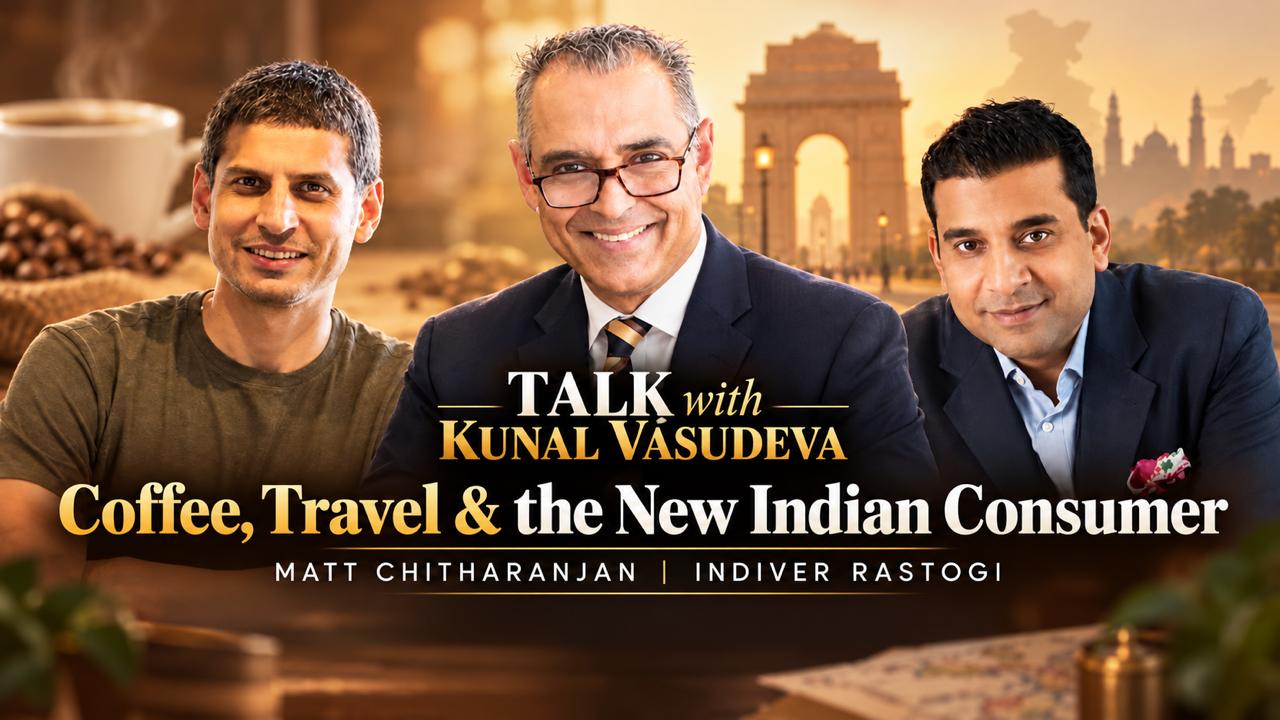
    The thought behind a conversation with Matt Chitharanjan and Indiver Rastogi.

    I have been thinking about something for a while now. Why do we consume what we consume? What makes us want certain things? And at what point does something that was once a luxury become a habit, or even a part of our everyday lives?

    Take coffee, for example.

    India has been growing coffee for generations. Yet, somewhere along the way, our relationship with coffee began to change. We started asking where the beans came from, how they were roasted, how the coffee was brewed. We were willing to pay more for a better cup. Cafés became places to work, meet, talk or simply spend time.

    I find that fascinating. What changed? Was it greater income, more exposure, better products or simply the desire for a different experience? And how does someone recognise that shift early enough to build a business around it?

    Now think about travel.

    I have spent much of my professional life around hospitality and tourism, and I remain endlessly curious about how this economy actually works.

    Why are Indians travelling so much more? Why are we discovering places within our own country that we rarely considered visiting earlier? Why are smaller destinations becoming popular? Why are families willing to spend considerable amounts on holidays, sometimes several times a year?

    And then there is international travel. More Indians are looking beyond the familiar destinations. Some travel for food, some for culture, some for adventure. Many simply want to see and experience more of the world.

    What is driving all this?

    Is it income? Better roads, airports and connectivity? Social media? Or has something more fundamental changed in how Indians think about spending their money?

    I am equally interested in what happens behind all this demand. Because tourism is an extraordinary economic engine. A flight fills a hotel. A hotel supports restaurants, taxis, shops and local businesses. A small town suddenly finds new customers for things it has been producing for years. Jobs get created, incomes improve and more people enter the economy.

    But I often wonder whether our infrastructure, our skills and our businesses are keeping pace with our appetite to travel. And whether we fully understand the opportunity sitting within domestic tourism itself.

    That is where the idea for this conversation began.

    I wanted to bring together two people who look at India from entirely different vantage points.

    Matt Chitharanjan, who co-founded Blue Tokai, started with a very personal problem around finding good coffee. From there, he helped build a business around a category that was still developing in India.

    Indiver Rastogi has spent over two decades in travel, with Air France and Thomas Cook. He has watched how Indians travel, how their expectations have changed and how the industry has had to respond.

    I was curious to hear them together.

    Because when you think about it, coffee and travel have quite a lot in common. Both depend on aspiration. Both are shaped by exposure and experience. Both involve people making choices about what matters to them and what they are willing to pay for.

    And both tell us something about where India is heading.

    Then comes another question that interests me. How do you build a business around these changing choices? How do you know whether you are seeing a passing trend or a market that will last? And once that market grows, how do you protect the quality of the experience while serving thousands, perhaps millions, of customers?

    There is also something to learn from the two men themselves. One built a business as an entrepreneur. The other built his career within large organisations. I wanted to understand how differently they see growth, people, training, leadership and the responsibility that comes with scale.

    And, of course, where their thinking meets.

    I certainly didn’t expect coffee and travel to explain the Indian economy. That would be rather ambitious for a podcast. But I did feel that putting these two people together might help us understand a small, interesting part of it.


    For me, that was the real reason for recording this conversation.

    I wanted to look beyond the products we buy and the journeys we take. I wanted to understand the choices behind them. The businesses that make those choices possible. And the opportunities they create for India.

    As India grows, how are we changing with it?

    That is what I wanted to explore with Matt and Indiver.

    And I hope you enjoy listening to this conversation as much as I enjoyed having it.

    Kunal Vasudeva

    TALK with Kunal Vasudeva | Matt Chitharanjan × Indiver Rastogi

    FRIDAY, 9 OCTOBER 2026 • YOUTUBE + SPOTIFY
  • ISH IDEAS | A CONVERSATION WITH ANIL CHOPRA

    ISH IDEAS | A CONVERSATION WITH ANIL CHOPRA

    ISH IDEAS | A CONVERSATION WITH ANIL CHOPRA

    Before the Market Exists

    What Anil Chopra’s journey through beauty, fashion, retail and services teaches us about building demand before a category is ready.

    Kunal Vasudeva

    Managing Director, Indian School of Hospitality

    Hospitality · Brand · Service · Leadership

    A question
    What if your biggest competitor is the absence of the category itself?

    THE PROPOSITION

    Before demand comes permission

    Some leaders compete for market share. Others have to build the market first.

    There was one question I wanted to stay with when I sat down with Anil Chopra: what do you do when the market itself is uncertain?

    For a large part of his career, Anil was building demand in a category India had barely decided it wanted. That is a different management problem from winning share in an established market. Before you can sell the product, you may have to make the category culturally acceptable. In other words, you have to create permission before you create demand.

    Lakmé is a useful place to begin. Tata records that the company was set up in 1952 after Jawaharlal Nehru raised concerns with JRD Tata about foreign exchange being spent on imported cosmetics. Tata’s advertising archive also notes that Lakmé’s early communication had to address the stigma around Indian women wearing make-up and educate consumers about cosmetics.1,2

    The product existed.
    Did permission exist?

    Young managers are often trained to study competitors. Anil’s story forces a harder question: what if your real competitor is the absence of the category itself?

    Timeline

    1952 1974 1998 2000 2009
    Lakmé is established Anil joins Lakmé Lakmé becomes Trent Fashion Week launches 140 salons reported

    A compressed timeline of the business story discussed in the conversation. Dates are sourced in the references at the end.

    BRAND BUILDING

    A brand is an idea. Experience is a system.

    He joined Lakmé in 1974. Over the years, the work moved from brand and distribution to fashion, salons and services. That sequence is interesting because each step reduced the company’s direct control over what the customer actually experienced.

    A brand can be designed centrally. Distribution decides whether anyone can buy it. A service adds another variable entirely: a human being.

    Lakmé Fashion Week is perhaps the clearest example of the brand choosing to build the world around its product. In a later account of the property, Anil described a branded event as a communication channel that had to compete for investment with television, print, outdoor and other media. He also recalled the problem Lakmé faced around 2000, when younger consumers increasingly saw it as “good, but my mother’s brand.” Fashion gave the brand a way to reconnect itself with youth, aspiration and contemporary culture.3

    Sell the product?
    Or build the world around it?

    That is a more interesting business move than sponsorship. You can advertise inside a category. Or you can help build the cultural platform that makes the category matter.

    SERVICE BUSINESS

    When the product becomes a person

    This is where the conversation starts to travel beyond beauty.

    In 2009, Business Standard reported that Lakmé’s service business included 140 salons, most operated through franchise partners. Around the same time, Anil told The Economic Times that the company was working to create “a service mindset” tuned to consumer needs.4,5

    That shift from product to service changes almost everything. A lipstick can leave a factory virtually identical every time. A service cannot. The customer meets a person, in a particular location, on a particular day, with all the judgement, skill, fatigue and personality that a person brings.

    When the product becomes a person
    How do you scale consistency without removing individuality?

    Leadership enters here as well. Service businesses are often described as difficult to scale because people introduce variance. That is true, but incomplete. People also bring judgement, warmth, recovery, improvisation and trust. The management task is not to engineer people out of the experience. It is to build systems that make good judgement more likely, and then give people enough confidence to use it.

    This is also where Anil’s journey becomes directly relevant to hospitality management. Hotels, restaurants, salons, airports, wellness businesses and luxury retail may look like different sectors. Yet the management problem is often remarkably similar. The brand promise is created centrally. The customer experiences it locally. Usually through a person.

    “Real estate matters. Technology matters. Process matters. Brand matters. Then comes the last metre.”

    THAT LAST METRE IS HUMAN.

    HOSPITALITY, REFRAMED

    The categories are starting to blur

    For hospitality education, this is a useful way to think about the future of the industry. Graduates need to understand operations, consumer behaviour, service design, retail economics, technology, human capital and leadership as parts of the same system. The experience economy does not respect old category boundaries.

    There is another interesting turn in the story. Tata records that in 1998 Lakmé divested its cosmetics business and moved into apparel retail, eventually becoming Trent Limited. The company again entered a field where established national brands were relatively scarce.6

    Cosmetics. Fashion. Salons. Retail.

    Different businesses, certainly. But all of them sit somewhere around aspiration, identity, experience and people.

    Perhaps that is why a conversation like this belongs at the Indian School of Hospitality. Hospitality has always been a people business. The larger management lesson now travels far beyond hotels.

    The graduates entering the industry today will probably work across businesses that do not fit neatly into the categories we use now. Some will manage established companies. Some will build platforms, concepts and service businesses that barely exist today.

    For the 19-year-old
    Would you rather enter a category? Or build one?

    Sometimes the opportunity starts before the market does.

    SOURCE TRAIL

    References and further reading

    Every historical or industry claim in the feature is anchored to a published source. The editorial interpretation remains the author’s.

    1. Tata Group – A Legacy of Empowerment
      Tata’s account of Jawaharlal Nehru persuading JRD Tata to establish an Indian cosmetics company.
      https://www.tata.com/newsroom/heritage/jamsetji-women-empowerment-tata-group
    2. Tata Group – From Jazz To Swadeshi Soaps
      Tata’s advertising archive on Lakmé’s early campaigns addressing stigma around make-up and educating consumers.
      https://www.tata.com/newsroom/tata-advertising-timeline
    3. Business Standard – Building the perfect property
      Anil Chopra’s first-person account of Lakmé Fashion Week as a brand property and communications platform, including the “mother’s brand” challenge around 2000.
      https://www.business-standard.com/article/specials/building-the-perfect-property-112052800050_1.html
    4. Business Standard – HUL hives off Lakme, Ayush Therapy into new arm
      Reports 140 Lakmé salons in 2009 and the predominantly franchise-led service network.
      https://www.business-standard.com/article/companies/hul-hives-off-lakme-ayush-therapy-into-new-arm-109010701059_1.html
    5. The Economic Times – Lakme changes makeup to fight competitors
      Interview with Anil Chopra on creating a service mindset tuned to consumer needs, and his 1974 start at Lakmé.
      https://economictimes.indiatimes.com/industry/cons-products/fashion-/-cosmetics-/-jewellery/lakme-changes-makeup-to-fight-competitors/articleshow/5154820.cms
    6. Tata Group – Trent Limited
      Tata’s corporate history of Lakmé’s 1998 divestment from cosmetics and transition into apparel and soft-goods retail.
      https://www.tata.com/business/trent

    Editorial note: This feature is based on Kunal Vasudeva’s conversation architecture for Anil Chopra and on the published sources above. It intentionally avoids attributing unverified statements to the recorded conversation.

Indian School Of Hospitality