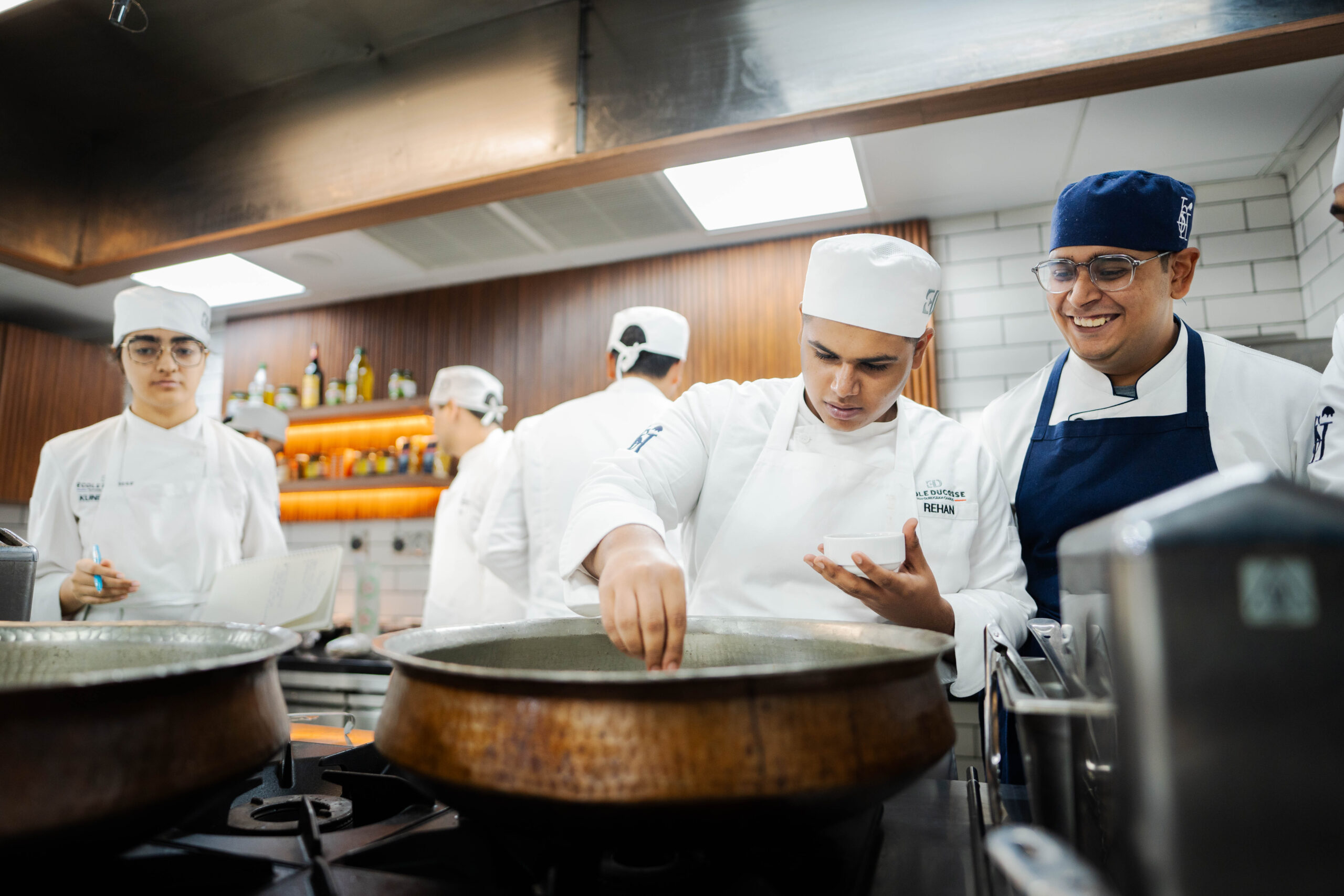
People study culinary arts to turn an interest in food into a professional craft with real career options. A good programme teaches technique, food safety, costing and kitchen leadership, and opens routes into hotels, restaurants, bakeries, F&B brands and food businesses of your own. It suits people who enjoy discipline as much as creativity.
This guide explains what culinary arts involves, the strongest reasons to study it, what the career looks like in India, how formal training compares with learning on the job, and who should think twice before enrolling. Where we use figures, we name the source and the date.
What Is Culinary Arts?
Culinary arts is the professional practice of preparing, cooking and presenting food, together with the systems that make a kitchen work: food safety, costing, purchasing, menu planning and team management. It covers savoury cuisine and, usually as a specialism, pastry and bakery.
Studying culinary arts means learning these skills in a structured sequence in professional kitchens, then applying them in real workplaces. Degree and postgraduate programmes add business subjects, so graduates can move into management or run their own food ventures.
At École Ducasse India, the Indian campus of École Ducasse on the ISH campus in Gurugram, you can study culinary arts through undergraduate and postgraduate programmes, or through dual-campus diplomas that continue in France or Singapore.
Why Study Culinary Arts? Seven Reasons
The strongest reasons to study culinary arts are a hands-on craft you can measure, a large and growing food economy in India, careers that reach beyond restaurant kitchens, a direct route to entrepreneurship, skills that travel internationally, a faster path to kitchen leadership, and work that combines creativity with discipline.
1. You learn a hands-on craft you can see and measure
Culinary education is mostly practical. You build knife skills, mise en place, stocks, sauces, cooking methods and plating, and you are assessed on the dishes you produce, not only on written exams. Progress is visible: a dish is either consistent service after service, or it is not.
For people who learn best by doing, that is a strong reason in itself. Every skill you practise, from portion control to hygiene routines, is used daily in a working kitchen.
2. India’s food services sector is large and still growing
According to the National Restaurant Association of India’s India Food Services Report 2024, the sector was worth about ₹5.69 lakh crore in FY24, directly employed about 8.5 million people, and was projected to reach about ₹7.76 lakh crore by FY28, with the organised segment growing at 13.2% a year.
A newer NRAI and Redseer Strategy Consultants report, reported in July 2026, projects the market to reach about US$150 billion by FY31. It expects organised brands, including quick-service chains, cafés, cloud kitchens and casual dining, to take a growing share of spending. That matters for culinary graduates, because organised operators typically hire into defined roles with training programmes and promotion ladders.
3. The career paths go well beyond restaurant kitchens
Most culinary careers start in a kitchen brigade, moving from commis chef to chef de partie, sous chef and head chef. The same training also leads to many other destinations:
Hotels and resorts, including banqueting and multi-outlet kitchens.
Bakeries, patisseries and chocolate businesses.
Members clubs, catering companies and cloud kitchens.
F&B brands, product development and food marketing.
Hospitality education and training.
Many professionals spend their early years cooking before moving into operations, product or brand roles, because kitchen experience gives them credibility with chefs later.
4. It is one of the most direct routes to running your own food business
Many people study culinary arts because they want to open a café, bakery, cloud kitchen or restaurant. Training that covers costing, menu engineering, purchasing, food safety and people management matters here, because those skills often decide whether a food business survives.
In ISH’s Class of 2026, 27% of graduates across its liberal hospitality and culinary arts undergraduate programmes chose entrepreneurship or a family enterprise as their outcome, reported separately from placement. École Ducasse India’s B.A. (Hons.) in Culinary Arts at ISH offers an Entrepreneurship specialisation from Semester 5, in which students design new business ideas and test them with mentors.
Food businesses in India are also regulated. Under the FSSAI FoSTaC programme, food businesses holding central or state licences should have at least one trained and certified Food Safety Supervisor for every 25 food handlers on each premises. Culinary training that takes food safety seriously prepares you for that responsibility.
5. Culinary skills travel internationally
Core cooking techniques and kitchen systems are shared across the world, which makes culinary skills portable. Your right to work in another country still depends on its visa and labour rules, but international training and work experience make the move easier.
Experienced kitchen leaders remain in demand in mature markets. In the United States, the Bureau of Labor Statistics projects employment of chefs and head cooks to grow 7% from 2025 to 2035, with about 25,200 openings a year on average. That figure describes the US labour market only.
At École Ducasse India, the diplomas are dual-campus pathways: the Culinary Arts Diploma continues at École Ducasse Paris, and the Diploma in Culinary Arts continues at At-Sunrice GlobalChef Academy in Singapore, both with a paid internship.
6. Formal training can shorten the path to leadership
You do not need a qualification to cook professionally. The US Bureau of Labor Statistics notes that chefs and head cooks typically need a high school diploma and work experience, and that some attend culinary programmes while others learn through apprenticeships.
What formal training adds is sequence and breadth. You learn foundations, food safety, costing and management in a set order, rather than depending on which kitchen and which chef you happen to train under. That foundation helps when you are ready to run a station, a kitchen or a business.
7. It combines creativity with discipline
Culinary arts rewards creativity, but professional kitchens run on precision, timing and repetition. Chef Manish Mehrotra, quoted on the B.A. (Hons.) in Culinary Arts page, names the values that build great kitchens as “discipline, simplicity, and respect for process”.
If you enjoy getting the same dish exactly right every time, and then finding ways to improve it, culinary arts is likely to suit you.
Why Study Culinary Arts Formally Instead of Learning on the Job?
Study culinary arts formally if you want structured foundations, management skills, a recognised credential or international pathways. Learning on the job can be enough if you already have access to a strong kitchen and mentor, and you do not need a qualification for further study or work abroad.
Factor
Formal culinary education
Learning on the job
Upfront cost
Tuition and living costs
Low; you earn from the start
Foundations
Taught in sequence: technique, food safety, costing
Depends on the kitchen and the chef
Business and management skills
Built into degree and postgraduate programmes
Learned informally, if at all
Credential
A recognised qualification for jobs and further study
None
International options
Partner campuses and internships abroad
Harder to arrange
If you are a graduate switching into culinary arts, the one-year PGCM in Culinary Arts at École Ducasse India, ISH combines professional kitchen training with management and entrepreneurship, and ends with a structured work attachment.
Is Culinary Arts a Good Career in India?
Culinary arts can be a good career in India if you are prepared for demanding early years. Pay usually starts modestly and rises through promotion, and the work involves long shifts, evenings and weekends. Graduates who keep building skills can progress into sous chef, head chef, management or business ownership.
Salaries depend on the employer and the career ladder you join. For École Ducasse India’s B.A. (Hons.) in Culinary Arts Class of 2026, ISH’s Class of 2026 Graduate Outcomes report records a median management training salary of ₹3.6 lakh per annum, rising to a median of ₹6.0 lakh per annum on completion of the employer’s training programme, based on confirmed records. That is one cohort at one school, so treat it as a benchmark, not a promise.
Working conditions matter as much as pay. The US Bureau of Labor Statistics describes chefs and head cooks as often working early mornings, late evenings, weekends and holidays in a hectic, fast-paced environment. Before committing, spend time in a professional kitchen to see whether that rhythm suits you.
Who Should Study Culinary Arts?
Culinary arts suits people who like physical, practical work, stay organised under pressure and are willing to repeat a technique until it is right. It suits people less well if they want predictable office hours or expect a senior title soon after graduating.
Culinary arts is likely to suit you if you:
Enjoy working with your hands and seeing results quickly.
Stay calm and organised when orders are coming in fast.
Are happy to repeat a technique until it is consistent.
Are curious about ingredients, cuisines and how food businesses work.
Want the option of running your own food venture one day.
Think twice if you:
Want a predictable nine-to-five schedule.
Dislike physical work and long periods on your feet.
Expect a senior title soon after graduating.
Are drawn mainly by television cooking rather than daily service.
The simplest test is to spend a few days in a professional kitchen or take a short course before committing to a full programme. ISH’s short-term programmes include Explore the Fundamentals of Food, which covers knife skills, pasta, sauces and balance.
Why Study Culinary Arts at École Ducasse India?
École Ducasse India is the Indian campus of École Ducasse, hosted on the ISH campus in Gurugram. Its programmes combine professional kitchen training and chef-mentors with business subjects and structured work attachments with hospitality and F&B brands.
École Ducasse India at ISH — the Indian campus of École Ducasse, named the World’s Best Culinary Training Institution three consecutive times in 2023, 2024 and 2025.
12 months (ENSP, Yssingeaux) or 16 months (At-Sunrice)
Candidates focused on pastry, bread and chocolate
ISH reports on its Impact in Numbers page that 80% of its students are supported through need-based scholarships, and that about 25% have progressed to Les Roches and École Ducasse for second degrees at undergraduate, diploma and postgraduate levels.
Common Misconceptions About Studying Culinary Arts
“Culinary arts is just cooking.” It also covers food safety, costing, purchasing, menu planning and team leadership.
“A culinary qualification makes you a head chef.” It speeds up your foundations; senior titles still come from years of performance.
“Culinary careers mean restaurants only.” Hotels, bakeries, clubs, catering, F&B brands and education all hire culinary talent.
“You must already be a skilled cook to enrol.” Good programmes teach foundations from the start, including classical techniques, knife skills, mise en place, stocks and sauces.
“Passion is enough.” Stamina, reliability and consistency matter just as much in the first years.
Frequently Asked Questions
Why should I study culinary arts?
Study culinary arts if you want to turn an interest in food into a professional craft with real career options. Good programmes teach technique, food safety, costing and kitchen leadership, and lead to roles in hotels, restaurants, bakeries, F&B brands and food businesses of your own. It suits people who enjoy discipline and repetition as much as creativity.
Is culinary arts a good career in India?
It can be, if you accept demanding early years. India’s food services sector directly employed about 8.5 million people in 2024, according to NRAI. Pay usually starts modestly and rises through promotion; for ISH’s B.A. (Hons.) in Culinary Arts Class of 2026, the median rose from ₹3.6 lakh per annum during training to ₹6.0 lakh per annum on completion.
What do you learn in a culinary arts programme?
You learn cooking techniques, knife skills, mise en place, stocks and sauces, pastry foundations, plating, food safety and kitchen discipline. Degree and postgraduate programmes add business subjects such as costing, operations and entrepreneurship, plus structured work attachments where you apply your training in real hospitality and F&B workplaces.
Do I need culinary school to become a chef?
No. Many chefs learn on the job, and the US Bureau of Labor Statistics notes that chefs and head cooks typically need a high school diploma and work experience. Culinary school is a faster, more structured route that adds management skills, a recognised credential and international pathways, which help if you want to lead kitchens, study further or work abroad.
Can I study culinary arts after Class 12?
Yes. School leavers can apply to undergraduate programmes such as École Ducasse India’s B.A. (Hons.) in Culinary Arts at ISH, an eight-semester Gurugram University degree that combines culinary and pastry techniques with business subjects and two structured work attachments. Check each programme’s admissions page for current eligibility requirements.
Is culinary arts only about working in restaurants?
No. Culinary graduates work in hotels and resorts, bakeries and patisseries, members clubs, catering companies, cloud kitchens, F&B brands, product development, food marketing and hospitality education. Many start in a kitchen because that experience gives them credibility later, then move into management, brand or business roles.
Next Step: Test Your Interest, Then Compare Programmes
If culinary arts appeals to you, test it before you commit: spend time in a professional kitchen or take a short course. Then compare programmes on credential, kitchen time, work attachments, international options, total cost and verified graduate outcomes for their most recent culinary cohort.
The best culinary degree in India is the one that gives you a recognised qualification, extensive time in professional kitchens, structured work experience with real employers, business skills and verified, dated graduate outcomes. No single programme is best for every student, so judge each one on those five points rather than on its reputation alone.
For school leavers who want both kitchen skill and a management career, École Ducasse India’s B.A. (Hons.) in Culinary Arts at ISH is built around those points. It is an eight-semester Gurugram University degree that combines culinary and pastry techniques with business subjects, two structured work attachments and a specialisation from Semester 5, with an optional final year at École Ducasse Paris or ENSP in France.
École Ducasse India at ISH — the Indian campus of École Ducasse, named the World’s Best Culinary Training Institution three consecutive times in 2023, 2024 and 2025.
If a four-year degree is not the right fit, École Ducasse India also offers shorter routes on the ISH campus in Gurugram: the one-year, AICTE-approved PGCM in Culinary Arts for graduates and career changers, and diploma programmes that begin in Gurugram and continue in France or Singapore. The rest of this guide shows how to compare these options against the careers, salaries and hiring timelines they lead to.
Culinary Careers at a Glance
A culinary degree or diploma prepares you for professional kitchen roles such as commis chef, chef de partie and, with experience, sous chef, as well as careers in hotels, bakeries, members clubs, catering, F&B brands, product development and food entrepreneurship. It does not guarantee a job. Your outcome depends on training quality, internships, skills and the employer ladder you join.
This guide answers the questions students, parents and career changers ask most often before choosing culinary education: what jobs exist, how long hiring takes, what graduates actually earn, whether culinary school is necessary and whether it is worth the cost. Where we use figures from Indian School of Hospitality (ISH) and École Ducasse India, we say which cohort and date they describe. Where we use industry data, we name the source.
Question
Short answer
What jobs can culinary graduates get?
Kitchen brigade roles in hotels, restaurants, bakeries and clubs, plus catering, cloud kitchens, F&B brands, product development, food marketing, hospitality education and entrepreneurship.
Do you need culinary school to cook professionally?
No. Many chefs learn on the job. Formal training speeds up foundations and opens management and international pathways.
How long until a graduate is hired?
Often around graduation, through internships and pre-placement offers, but timelines vary. No school can honestly guarantee a job.
What do graduates earn at the start?
For ISH’s B.A. (Hons.) Culinary Arts Class of 2026, the median was ₹3.6 lakh per annum during employer training and ₹6.0 lakh per annum on completion.
Is culinary school worth it?
It can be, when the programme’s cost, length, internships and employer network match your goals. ROI depends on those variables, not on the certificate alone.
Do You Need Culinary School to Cook Professionally?
No. Formal education is not required to work in a professional kitchen, and many successful chefs learned entirely on the job. The US Bureau of Labor Statistics notes that most chefs and head cooks learn their skills through work experience, typically starting as line cooks and spending years in kitchens before promotion. Culinary school is a faster, more structured route, not the only route.
Whether it is the right route depends on what you want in five to ten years, not just what you want to cook next month.
Factor
Formal culinary training
Learning on the job
Upfront cost
Tuition and living costs, sometimes abroad
Low; you earn from day one
Speed of foundations
Structured: technique, food safety, costing and theory in sequence
Depends on your kitchen and chef; can be uneven
Entry point
Often management training or organised-sector roles
Formal training tends to pay off most when you want to lead kitchens or businesses, work for organised employers, study or work abroad, or keep the option of a management career outside the kitchen. Learning on the job can be enough when you are certain about a specific kitchen, have access to a strong mentor chef and do not need a formal credential.
How do I know if a culinary career is right for me?
Test the reality before you commit to years of study. Professional kitchens involve long shifts on your feet, evening and weekend work, heat, pressure and repetition. People who thrive usually enjoy the discipline as much as the creativity.
Spend a few days shadowing in a professional kitchen, even unpaid, to see a real service.
Cook the same dish repeatedly until it is consistent; professional cooking is about consistency more than novelty.
Visit campuses, meet current students and ask what their weeks look like. ISH hosts campus events and open days.
Is a Culinary Qualification Recognised by Employers?
A culinary qualification is only as recognised as the body that awards it, so check who issues the certificate. At ISH, recognition comes from several sources, as set out on its accreditations and memberships page:
The B.A. (Hons.) in Culinary Arts is a Gurugram University degree. ISH states the qualification carries legal validity across India in line with UGC norms. Students who transfer to France for their final year also earn an International Bachelor’s Degree from École Ducasse.
The Postgraduate Certificates in Management in Culinary Arts and Bakery and Pastry are AICTE-approved.
All ISH culinary programmes are delivered under the École Ducasse academic framework. École Ducasse was named World’s Best Culinary Training Institution at the World Culinary Awards in 2023, 2024 and 2025.
Can culinary graduates work anywhere in the world?
Culinary skills are highly portable, but the right to work abroad depends on each country’s visa and labour rules, not on your qualification alone. International pathways make the move easier. For the Paris diploma, École Ducasse’s career development centre guides graduates on work pathways available under French law. Across both ISH undergraduate programmes, 15% of the Class of 2026 moved into international pathways.
How to Choose the Right Culinary Programme
Choose a culinary programme by matching its length, credential, practical hours and career outcomes to your goal, then verify its claims. Start with where you want to be in five years, whether that is running a hotel kitchen, opening a bakery or working abroad, and work backwards.
Define your goal: kitchen leadership, pastry, entrepreneurship, international work or a management career.
Check the credential: who awards it, and is it recognised for jobs and further study?
Count practical time: hours in professional kitchens and the length and pay of internships.
Verify outcomes: ask for dated, cohort-specific placement and salary data for culinary graduates.
Meet the faculty: chef-faculty with industry experience shape your network.
Calculate total cost: include living costs, international phases and financial aid.
ISH’s culinary portfolio at École Ducasse India illustrates how the options differ:
Programme
Duration
Where
Qualification
Best suited to
B.A. (Hons.) in Culinary Arts
Eight semesters
Gurugram, with an optional final year at École Ducasse Paris or ENSP
Gurugram University degree; École Ducasse certification or degree
School leavers who want culinary skill plus a business specialisation
PGCM in Culinary Arts
12 months
Gurugram
AICTE-approved postgraduate certificate
Graduates, career changers and aspiring founders
Culinary Arts Diploma, École Ducasse Paris
12 months
Gurugram and Paris
École Ducasse Paris diploma
Candidates aged 18 or above seeking French culinary training
Diploma in Culinary Arts, At-Sunrice
16 months
Gurugram and Singapore
SSG-recognised At-Sunrice diploma
Candidates wanting Asian and contemporary cuisine and a paid Singapore internship
A good culinary programme is mostly practical. You spend extensive time in professional-grade kitchens building technique, speed and discipline, and then apply it in real workplaces through internships or work attachments. The better programmes add business skills such as costing, menu design and operations management.
What to expect from culinary training
At ISH, the foundations phase of the culinary diplomas covers classical techniques, knife skills, mise en place, stocks and sauces, kitchen discipline, food safety and HACCP, and the basics of menu thinking. Later phases add advanced cuisine, plating, restaurant operations and, depending on the programme, French gastronomy or Asian and contemporary cuisine. The four-year B.A. (Hons.) in Culinary Arts combines culinary and pastry techniques with business subjects and two structured work attachments.
Expect uniforms, hygiene standards, punctuality rules and practical assessments. Culinary school mirrors a professional kitchen deliberately, because that is where you will be judged.
What should culinary students know before enrolling?
Your first job is likely to be junior, even with a degree. Qualifications speed up progression; they rarely let you skip the line entirely.
Internships shape your first job more than grades do. Treat them as long interviews.
Physical stamina and reliability matter as much as talent in the first years.
Specialising early, in pastry for example, can help, but a broad foundation keeps options open.
Read any placement statistic together with its definition and date.
How culinary schools connect students to jobs
Culinary schools connect students to employers through built-in internships, industry relationships, recruiter visits and career services. At ISH, the Centre for Career Development works with the Centre for Life Skills to match students with employers on company-student fit, through internships, mentorships and full-time roles.
International diplomas at ISH build paid work experience into the programme itself:
The Culinary Arts Diploma with École Ducasse Paris is a 12-month pathway, 3 months in Gurugram and 9 months in Paris, including a four-month paid internship in France with a stipend of €450 to €600 per month, depending on the employer.
Employers of ISH’s Class of 2026 included Marriott International, which made culinary pre-placement offers, alongside hotel groups such as The Oberoi Group, The Leela and Hilton, and food businesses such as Manam Chocolate.
Questions to ask any culinary school about placement support
What percentage of last year’s culinary cohort had confirmed offers, and on what date was that measured?
Does the figure include students who chose entrepreneurship, further study or opted out, or are they reported separately?
Which employers hired culinary graduates specifically, not the whole school?
What was the median starting salary, and is it the training salary or the post-training salary?
Are internships guaranteed, paid and assessed?
What Can You Do With a Culinary Degree or Diploma?
A culinary qualification leads first to professional kitchen roles, most commonly as a commis chef or management trainee, and from there to senior brigade positions. It also opens careers outside restaurant kitchens: hotels and resorts, members clubs, bakeries and patisseries, catering, production kitchens, F&B brands, food marketing, hospitality education and your own food venture.
The breadth matters because the food economy is large and still formalising. The National Restaurant Association of India’s India Food Services Report 2024 estimates the sector at about ₹5.69 lakh crore, employing roughly 8.5 million people directly, with the organised segment projected to grow at 13.2% a year to 2028. Organised operators, from hotel chains to multi-brand restaurant groups, are the employers most likely to hire trained culinary graduates into structured roles.
Kitchen careers: the brigade ladder
Most culinary careers begin inside a kitchen brigade, the hierarchy used by hotels and serious restaurants. Titles vary between employers, but the progression is broadly consistent:
Commis chef or kitchen trainee: the entry role, preparing ingredients and executing set recipes on one station under supervision.
Demi chef de partie and chef de partie: running a station, such as sauces, grill, garde manger or pastry, and training juniors.
Junior sous chef and sous chef: managing shifts, ordering, rostering, costing and quality across the kitchen.
Head chef or executive chef: owning menus, food cost, hiring and the kitchen’s standards; in hotels, often overseeing several outlets.
Pastry and bakery follow a parallel ladder, leading to pastry chef, head baker or chocolatier roles.
Culinary career paths beyond restaurant kitchens
Not every culinary graduate stays on a restaurant line. Employers of ISH’s Class of 2026 across its hospitality and culinary programmes came from hotels and resorts, F&B brands and breweries, restaurants and cafés, members clubs, experiential and boutique hospitality, mobility and retail, and hospitality education, according to the ISH Class of 2026 Graduate Outcomes report. ISH’s programme pages list further destinations for culinary and pastry graduates:
Bakeries, patisseries and dessert studios.
Food studios and production kitchens.
Catering companies and cloud kitchens.
F&B management, concept development and franchise operations.
Nutrition-focused food ventures and consulting.
Food marketing and PR, a pipeline in process for ISH’s Class of 2026 culinary graduates.
These paths reward the same foundations as a kitchen career, so many professionals spend their early years cooking before moving into product, operations or brand roles.
Do all culinary graduates work in kitchens?
Most start there, and that is usually an advantage rather than a limitation. For ISH’s B.A. (Hons.) Culinary Arts Class of 2026, confirmed placements were concentrated in culinary operations, with a smaller marketing and PR pipeline still in process. Kitchen experience is what gives a food marketer, product developer or F&B manager credibility with chefs later.
Can culinary training lead to owning a food business?
Yes, when the training covers business as well as cooking. Costing, menu engineering, supply chains, food safety compliance and people management decide whether a restaurant, bakery or cloud kitchen survives, often more than recipes do. Across both ISH undergraduate programmes, 27% of the Class of 2026 chose entrepreneurship or family enterprise as their outcome, reported separately from placement.
ISH builds this in two ways. The B.A. (Hons.) in Culinary Arts offers an Entrepreneurship specialisation from Semester 5, where students design and test a venture concept with mentors. The Postgraduate Certificate in Management in Culinary Arts is designed partly for aspiring founders and family-business participants who want to professionalise operations.
One practical point for founders in India: licensed food businesses are expected to have at least one trained and certified Food Safety Supervisor for every 25 food handlers on each premises under FSSAI’s FoSTaC programme. Food safety is a legal and operational foundation of any food business, not an afterthought.
What Employers Look For in Culinary Graduates
Employers hiring culinary graduates look first for reliability, sound fundamentals and food safety discipline, then for speed, consistency, teamwork and the ability to take feedback. Creativity matters, but in the first years it counts only after you can execute the menu exactly as specified, every service.
Technique fundamentals: knife skills, mise en place, stocks, sauces and cooking methods executed consistently.
Food safety: HACCP principles and hygiene habits. Food safety is regulated in India through FSSAI requirements such as trained Food Safety Supervisors.
Speed and organisation: a clean, prepared station and the ability to work to ticket times.
Teamwork and communication: kitchens run on clear call-and-response and mutual support.
Cost awareness: understanding portioning, yield and waste signals management potential.
Coachability and stamina: turning up on time, every shift, and improving from feedback.
What employers expect from new culinary graduates in the first months
Expect to be tested on basics before you are trusted with more. New graduates typically prove themselves on prep and one station, learn the kitchen’s recipes and standards exactly, and show they can handle a full service. Graduates who ask questions, take notes and volunteer for extra prep tend to be moved up fastest.
How culinary graduates stand out to employers
Treat every internship as a trial; many first jobs come from internship employers.
Keep a photo and recipe portfolio of dishes you have executed professionally.
Build a specialism alongside a broad base, such as pastry, a regional cuisine or bread.
Learn the business side: food cost, menu engineering and inventory.
Get international exposure where possible; it signals adaptability.
How Long Does It Take a Culinary Graduate to Get Hired?
Many culinary graduates receive offers during or shortly after their final internship or work attachment, often as pre-placement offers from the employer they trained with. Others take a few months to find the right role, particularly if they are selective about city, cuisine or employer. No reputable school can guarantee a job or a timeline.
For a real benchmark, ISH’s Class of 2026 Graduate Outcomes report documents every graduate of its B.A. (Hons.) Culinary Arts programme, which began in 2022. As recorded on 7 July 2026:
41% of the culinary cohort held confirmed offers.
73% held confirmed offers or offers in process, such as verbal confirmations and offer letters awaited.
The remaining graduates were reported under distinct outcomes: entrepreneurship and family enterprise, international pathways, higher studies, exploring options and opting out of the placement process.
The report treats entrepreneurship and further study as chosen outcomes rather than failures, and excludes offers in process from its salary statistics until they are confirmed in writing. That level of disclosure is what to look for when comparing schools.
Do restaurants and hotels hire fresh culinary graduates?
Yes. Hotels, restaurant groups and bakeries hire fresh graduates into entry-level brigade roles and structured management training programmes. NRAI projects direct employment in Indian food services to grow from about 8.5 million people in 2024 to about 10.3 million by 2028, which sustains steady demand for trained kitchen talent. Competition is stiffer for the most prestigious kitchens, where employers can choose from many applicants.
Will culinary school guarantee me a job?
No, and you should be wary of any school that promises one. A strong programme improves your odds through technique, internships and employer relationships. Your outcome still depends on how you perform during internships, how flexible you are about role and location, and whether you keep building skills after graduation.
What is the culinary job market really like?
The Indian food services market is large and growing, but the work is demanding. NRAI estimates the industry will reach about ₹7.76 lakh crore by 2028, growing at 8.1% a year, with the organised segment growing faster than the unorganised one. For graduates, that means more structured employers with training programmes and career ladders. It also means competition for the best roles and early-career pay that rises mainly through promotion.
The honest picture: entry is achievable for trained, reliable graduates; progression is earned; and the first two to three years are the hardest physically and financially.
What is life like after culinary school?
Life after culinary school usually begins with a structured training period at an employer, such as a hotel management training programme or a kitchen rotation, followed by a permanent role on a station. Expect shift work, a steep learning curve and frequent feedback. Graduates who treat the first year as a paid extension of their education tend to progress fastest.
How Much Do Culinary Graduates Earn in India?
Starting salaries for culinary graduates in India vary widely by employer and career ladder. For ISH’s B.A. (Hons.) Culinary Arts Class of 2026, the median management training salary was ₹3.6 lakh per annum, rising to a median of ₹6.0 lakh per annum on completion of the employer’s training programme, based on eight confirmed records.
Career ladder (Class of 2026, culinary)
Management training salary (₹ LPA)
On completion of training (₹ LPA)
Premium kitchen management ladder
4.80
9.00
Hotel and standalone culinary brigade ladder (operations)
3.00
6.00
Boutique kitchen management ladder
3.60
5.00
Cohort median
3.60
6.00
Source: ISH Class of 2026 Graduate Outcomes report, confirmed records as of 7 July 2026. LPA means lakh per annum. The figures describe one cohort and one school; they are a benchmark, not a promise.
Several factors move a starting salary more than the qualification itself:
Employer ladder: premium and luxury kitchens tend to pay more on completion than standalone brigades.
Training structure: management training programmes pay less during training and step up on completion.
City and segment: metro hotels and premium restaurants usually pay more than smaller markets.
Specialisation: pastry, bakery and specific cuisines can command different rates depending on demand.
International experience: paid internships abroad, such as those in France and Singapore, add earnings during study and experience employers value.
For international context, the US Bureau of Labor Statistics reports a 2025 median pay of $62,470 for chefs and head cooks and $36,640 for cooks. These figures reflect a different labour market and cost of living, so they are useful for understanding the gap between junior and senior roles, not for converting into rupees.
How Quickly Can Culinary Graduates Advance?
Advancement in kitchens is earned through performance and time on stations. The US Bureau of Labor Statistics notes that chefs and head cooks typically need a high school diploma plus work experience, with many spending years in kitchens before promotion. Professional certification in the US requires anywhere from about six months to five years of experience, depending on the level.
Formal training can shorten the path by giving you management skills earlier. The employer career ladders documented for ISH’s Class of 2026 culinary graduates map progression toward Junior Sous Chef, Sous Chef and Head of Kitchen roles at around the five-year stage. Actual progression depends on individual performance and the employer.
What accelerates promotion in practice: consistency under pressure, willingness to train juniors, understanding food cost and inventory, and moving deliberately between employers or outlets to gain breadth.
Watch: Chef Manish Mehrotra on the reality of a chef’s journey
In conversation with Kunal Vasudeva, Chef Manish Mehrotra talks about leaving Indian Accent at the height of his career to build Nisaba, his vision for modern Indian cuisine and what it takes to become a restaurateur. He also covers finding the right investors, building teams, nurturing young chefs and the discipline of the kitchen, drawing on more than 30 years in the culinary industry.
Is Culinary School Worth the Cost?
Culinary school is worth the cost when the programme’s total cost, length and credential match a clear career goal, and when it delivers real kitchen experience, internships and employer access. It is a poor investment when you are unsure about kitchen work, when the fees are high relative to likely starting salaries, or when placement claims cannot be verified.
Evaluate return on investment with the variables that actually determine it:
Total cost: tuition, living costs, travel and, for international pathways, visas and accommodation abroad.
Time out of the workforce: a four-year degree and a 12-month diploma have very different opportunity costs.
Earnings during study: paid internships reduce the net cost. ISH’s France and Singapore diploma phases include paid internships.
Starting ladder: the employer and training programme you join shape your pay trajectory more than your first salary.
Credential value: a recognised degree or internationally awarded diploma keeps options open for further study and work abroad.
Financial aid: ISH reports that about 80% of its students are supported through need-based scholarships under its Flourish financial aid programme.
ISH publishes current fees and timelines in its Admissions Guide, available from each programme’s admissions and fees page. Compare programmes on total cost against the verified outcomes of their most recent culinary cohort, not their best individual success story.
Should my teen attend culinary school? A guide for parents
If your child already cooks with discipline, enjoys the pressure of producing food for others and is curious about how food businesses work, culinary education can be a strong foundation for a real career. Parents usually worry about three things, and each has a practical answer.
Job security: look for verified, dated placement data for culinary graduates specifically, and ask how it was calculated.
Keeping options open: a degree such as the B.A. (Hons.) in Culinary Arts, awarded by Gurugram University, adds business specialisations and keeps the door open to postgraduate study.
Readiness: the international diplomas at ISH require applicants to be at least 18 with 10+2 or equivalent, so school leavers often choose a degree first.
A short course or a kitchen stint before enrolling is the most reliable way to test commitment.
Can Culinary School Help a Career Change?
Yes. Career changers usually choose an intensive diploma or a one-year postgraduate programme rather than a new four-year degree. At ISH, the AICTE-approved Postgraduate Certificate in Management in Culinary Arts accepts graduates of any discipline with a minimum 50% aggregate, with relaxation for eligible categories, and runs for 12 months including a three-month internship.
If pastry is your focus, the PGCM in Bakery and Pastry Arts at École Ducasse India, ISH is a one-year, AICTE-approved Postgraduate Certificate in Management covering applied pastry and bakery techniques, business and operations management, entrepreneurship and venture creation.
The international culinary diplomas are also open to career changers: beginners can apply, provided they are at least 18, have completed 10+2 or equivalent and meet the English language requirements. For career changers, the key question is whether you can accept an entry-level kitchen role and pay for the first year or two while you build skill.
Common Misconceptions About Culinary Careers
“A culinary degree makes you a head chef.” It gives you a head start on foundations and management skills; the title still comes from years of performance.
“Culinary means restaurants only.” Hotels, clubs, bakeries, catering, production kitchens, F&B brands and education all hire culinary talent.
“A 100% placement claim settles the question.” Placement rates depend on definitions. Ask who is counted, whether offers are confirmed and on what date.
“You need culinary school to be a chef.” You do not; you need skill and experience. School is a faster, more structured route with wider options.
“The first salary tells you the career’s value.” The career ladder you join matters more than the salary you start on.
Frequently Asked Questions
What jobs can I get with a culinary degree or diploma in India?
Most graduates start in professional kitchens as commis chefs or management trainees in hotels, restaurants, bakeries, patisseries and members clubs, then progress toward chef de partie and sous chef roles. Others move into catering, cloud kitchens, F&B brands, product development, hospitality education, food marketing or their own food ventures. Your first role usually depends on your internships and specialisation.
How long does it take to get a job after culinary school?
Many culinary graduates receive offers during or just after their final internship or work attachment, often as pre-placement offers. At ISH, 73% of the B.A. (Hons.) Culinary Arts Class of 2026 held confirmed offers or offers in process on 7 July 2026, with 41% confirmed. Timelines vary with season, city, flexibility and each employer’s hiring cycle.
What is the starting salary for a culinary graduate in India?
Starting pay varies by employer and career ladder. For ISH’s B.A. (Hons.) Culinary Arts Class of 2026, the median management training salary was ₹3.6 lakh per annum, rising to a median of ₹6.0 lakh per annum on completion of the employer’s training programme, based on eight confirmed records. Premium kitchen ladders paid more; smaller brigades paid less.
Do I need culinary school to become a chef?
No. The US Bureau of Labor Statistics notes that most chefs and head cooks learn their skills through work experience and that postsecondary education is not required. Formal training helps when you want structured foundations, faster entry into organised kitchens, management skills, international pathways or a recognised credential for further study.
Will culinary school guarantee me a job?
No school can honestly guarantee a job, so be cautious of any that does. A good programme improves your odds through technique training, structured internships, employer relationships and career support. Outcomes still depend on your performance, your flexibility on role and location, and the employer ladder you join. Ask schools how they define and calculate placement figures.
Can I work abroad after culinary school?
Culinary skills travel well, but your right to work abroad depends on each country’s visa and labour rules, not on your qualification alone. International pathways help: ISH’s diplomas with École Ducasse Paris and At-Sunrice GlobalChef Academy include paid internships abroad, and École Ducasse guides Paris graduates on work options available under French law.
Is a culinary degree recognised by employers in India?
Recognition depends on who awards the qualification. ISH’s B.A. (Hons.) in Culinary Arts is a Gurugram University degree, which ISH states carries legal validity across India in line with UGC norms. Its postgraduate certificates in Culinary Arts and Bakery and Pastry are AICTE-approved, and its international diplomas are awarded by École Ducasse Paris or At-Sunrice GlobalChef Academy.
Can I switch careers into culinary arts after graduating in another field?
Yes. Career changers commonly choose intensive diplomas or one-year postgraduate programmes rather than a new four-year degree. At ISH, the AICTE-approved Postgraduate Certificate in Management in Culinary Arts accepts graduates of any discipline with a minimum 50% aggregate, and the international culinary diplomas accept beginners aged 18 or above with 10+2 or equivalent.
What is the difference between a culinary degree and a culinary diploma?
A culinary degree is a longer academic qualification that combines kitchen training with business and general education; ISH’s B.A. (Hons.) in Culinary Arts runs over eight semesters. A diploma is shorter and more craft-focused, lasting 12 to 16 months at ISH, with international phases. Degrees suit school leavers who want management options; diplomas suit those who want speed.
Can culinary training help me start my own food business?
Yes, if it covers business as well as cooking. Costing, menu engineering, food safety compliance and operations decide whether a food venture survives. ISH’s B.A. (Hons.) in Culinary Arts offers an Entrepreneurship specialisation from Semester 5, and 27% of ISH’s Class of 2026 across both undergraduate programmes chose entrepreneurship or family enterprise as their outcome.
Next Step: Plan Your Culinary Career With Evidence
A culinary career rewards people who choose their training deliberately. Decide what you want to be doing in five years, test your commitment in a real kitchen or a short course, and compare programmes on credential, practical time, internships, total cost and verified outcomes for their latest culinary cohort.