ISH INSIGHTS / PODCAST
What Happens 15 Years After You Leave the Same Classroom?
By Kunal Vasudeva | October 30, 2026 | 5 min read
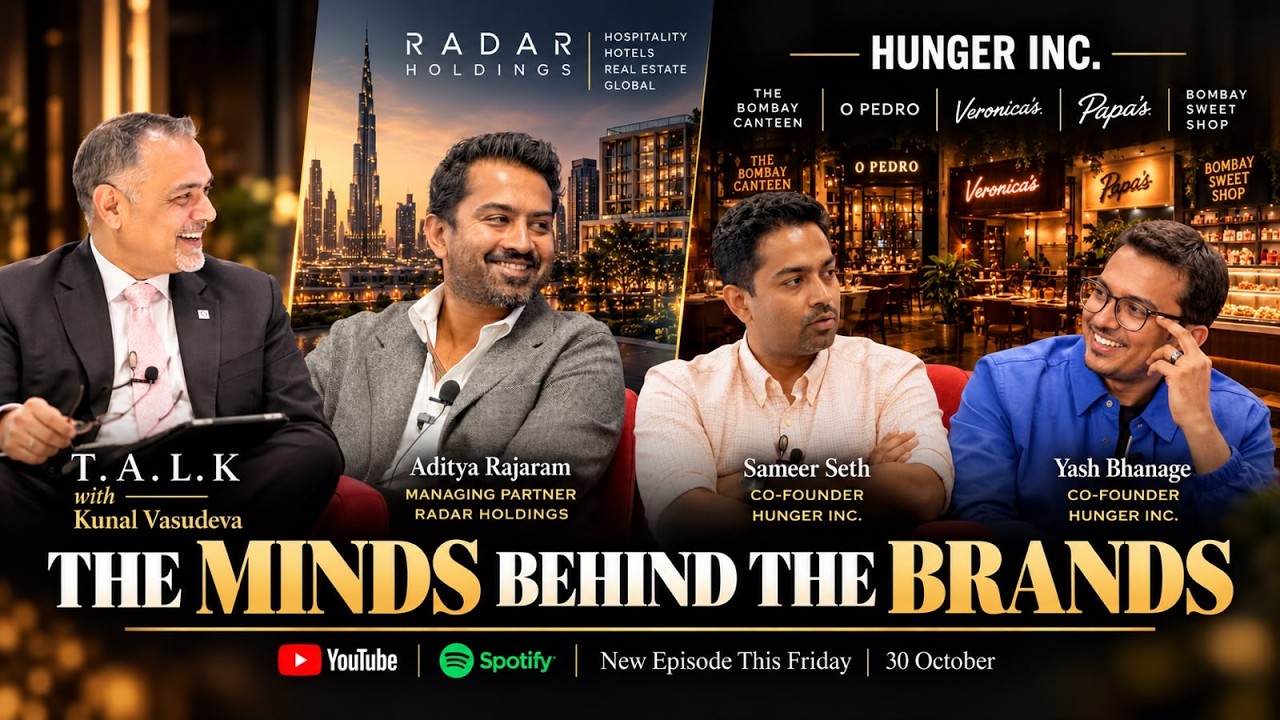
The thought behind a conversation with Sameer Seth, Yash Bhanage and Aditya Rajaram.
I have often wondered what happens to people who spend time in the same classroom. They study the same subjects, listen to the same professors, work on the same assignments and then, one day, go their separate ways.
Where do they end up 15 years later? How much of what they learnt actually stays with them? And what determines the choices they make along the way?
That was one of the reasons I wanted to record this conversation.
Three gentlemen who met at Cornell around 2010. Two went on to build some of India’s most interesting restaurant brands. The third pursued hotel investments, real estate and asset ownership in Dubai.
And the stories of how they got there are fascinating.
Take Sameer Seth and Yash Bhanage, for example.
Today, most people in the restaurant business would recognise Hunger Inc., the company behind The Bombay Canteen, O Pedro, Bombay Sweet Shop, Veronica’s and Papa’s.
But go back a few years, and their stories looked rather different.
Sameer was working at Citibank. He had studied chemistry, completed an MBA and was building a career in banking. Then came a difficult experience with a boss, and a decision to pursue something he had always loved: food.
His grandmother had a rather memorable reaction.
“Bank chhod ke parathe bechne ja rahe ho?”
I found that wonderful because it tells you something about how careers in hospitality were perceived in India, and perhaps still are in certain families.
Yash’s journey was equally interesting.
He grew up in Pune, studied hotel management at IHM Goa and began his career in operations at the Hyatt. His salary when he moved to Mumbai was ₹8,500 a month.
And he was enjoying himself.
He spoke about the long hours, the physical demands of hospitality and the satisfaction of learning the business from the ground up. At one point, he admitted that he never really expected to get into Cornell.
Yet there he was.
The two eventually met, worked internationally, and began discussing an idea that would bring them back to India.
Why Mumbai? Why Indian food? And why open a restaurant that deliberately challenged people’s expectations of what an Indian restaurant should serve?
Those questions led us to the story of The Bombay Canteen.
I was particularly interested in what happened after it opened in 2015.
Because when we look at successful businesses today, we tend to see the brands, the recognition and the expansion. We rarely see the original assumptions, the locations that didn’t work out, the people who took a chance on the founders or the decisions that could easily have gone wrong.
Sameer and Yash spoke candidly about all of this.
They also spoke about something I find particularly important in hospitality. Can you scale a business without losing the experience that made people fall in love with it in the first place?
Building one successful restaurant is difficult enough. Building five different brands, each with its own personality, customers and operational demands, raises an entirely different set of questions.
And then there was Aditya Rajaram.
Aditya is one of ISH’s founding investors and a member of our Board. He has also been a guest on an earlier episode of T.A.L.K., so I have known his story for some time.
But hearing him tell it alongside Sameer and Yash brought an entirely different perspective to the conversation.
Aditya had always wanted to be a hotelier. His interest eventually took him into hospitality real estate and hotel ownership in Dubai.
He decided to develop a hotel near Dubai’s planned second airport, believing that the airport and the surrounding development would create a strong business opportunity.
Then the airport development was put on hold.
Imagine having committed to a hotel project, borrowed money, signed agreements and built a financial plan around something that suddenly wasn’t going to happen as expected.
And then, of course, COVID arrived.
Aditya spoke about the pressure of having family money at stake, obligations to the bank and a business whose future was uncertain. He went without a salary for two and a half years and continued with the project.
I asked him what breaks you at a time like that.
His response was rather telling.
“What doesn’t break you?”
I think that part of the conversation will stay with me for a long time.
Because entrepreneurship often sounds wonderfully exciting when we discuss it in classrooms or read about it in business magazines. But what does it actually feel like when things go wrong? When you have employees depending on you, creditors expecting payment and your own reputation on the line?
And how do you find the confidence to keep going?
There was another aspect of this conversation that I thoroughly enjoyed.
We put the three of them on the spot.
Would Aditya invest in one of Hunger Inc.’s restaurant brands? Would Sameer and Yash ever consider franchising? What matters more to a restaurant, a Michelin star or a healthy margin? And what really kills a restaurant: bad food or bad mathematics?
Their answers made for some entertaining moments.
But underneath the laughter and banter was something much more meaningful.
All three spoke about the importance of people, consistency, judgment and understanding risk.
Yash made a point I particularly liked. Creativity means very little if you cannot deliver the same quality consistently. Sameer spoke about overcoming fear and finding the courage to take the first step. Aditya spoke about respecting the process, even when the outcome isn’t what you expected.
And I kept coming back to the fact that these three people had once shared a classroom.
They took very different decisions. They built different businesses. They encountered different challenges.
Yet there was a great deal of common ground in how they thought about people, responsibility, ambition and the decisions they made.
For our students at ISH, and for young people considering careers in hospitality, I think there is a great deal to take away from this conversation.
There is no single path to building a meaningful career. There will be difficult decisions, unexpected opportunities and moments when you question your own judgment.
And sometimes, you simply have to take the leap.
That was also my parting thought to the three of them.
At 54, I think I have earned the right to offer a little advice!
I thoroughly enjoyed recording this episode. There were some wonderful stories, plenty of laughter and a few moments that made all of us think.
As I said in the introduction, this one isn’t for 1.5x speed. If anything, it’s for 0.5x.
Take your time with it.
I hope you enjoy the conversation as much as I enjoyed having it.
Kunal Vasudeva
T.A.L.K. with Kunal Vasudeva | Sameer Seth × Yash Bhanage × Aditya Rajaram
FRIDAY, 30 OCTOBER 2026 • YOUTUBE + SPOTIFY